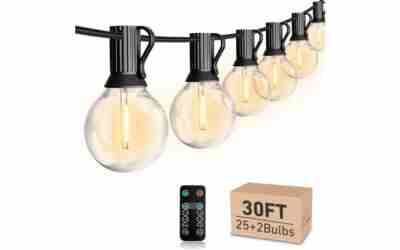
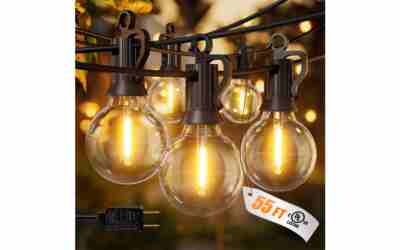
Plan on 50 to 100 mini lights per foot of tree height, so a 6-foot tree takes 300 to 600 lights. Go up to 150 per foot for a dense, store-display look. For the house, measure each run in feet and divide by the lit length of the strand. Below is how many Christmas lights to buy for trees, rooflines, windows and shrubs, plus how much extra to add.
How many Christmas lights for a tree
Multiply the tree’s height in feet by a density number. The right number depends on your bulbs and the look you want. Most trees fall between 50 and 100 per foot, and 150 is a dense option. Use the table to pick a starting point.
| Tree height | Sparse (50 per ft) | Medium (100 per ft) | Dense (150 per ft) |
|---|---|---|---|
| 4 ft | 200 | 400 | 600 |
| 6 ft | 300 | 600 | 900 |
| 7.5 ft | 375 | 750 | 1,125 |
| 9 ft | 450 | 900 | 1,350 |
| 12 ft | 600 | 1,200 | 1,800 |
Which column to use: Sparse is a restrained look and suits bright LED mini lights. Medium is the common default. Dense gives the packed, sparkly look of store displays, but it takes many strands, so check the connection limits and circuit load in the strands section below.
Adjust for tree width
Height alone ignores shape. A slim or pencil tree has far less branch area than a full one, so cut the count by about a quarter. For a very wide, full tree, add about a quarter. These are rules of thumb, not a standard.
Pre-lit trees
Count what is already on the tree (the box lists it). Many owners add one or two extra strands to fill gaps rather than starting from the full chart number.
Bulb type and spacing change the count
Shoppers buy strands, not totals, so convert the light count into feet. Lit length is roughly the number of gaps times the spacing, and a strand has one fewer gap than it has bulbs.
| Bulb style | Spacing | Calculation | Lit length |
|---|---|---|---|
| Mini, close spacing | 2.5 in | 99 gaps x 2.5 in = 248 in | 100 lights is about 21 ft |
| Mini, standard | 4 in | 99 gaps x 4 in = 396 in | 100 lights is about 33 ft |
| Mini, wide | 6 in | 99 gaps x 6 in = 594 in | 100 lights is about 50 ft |
| C9 large bulb | 12 in | 24 gaps x 12 in = 288 in | 25 bulbs is about 24 ft |
Spacing varies by brand, so read the box. The lit length does not include the plain lead wire at each end.
Example: a 6-foot tree at medium density needs 600 lights, or six 100-light strands. At 2.5-inch spacing each strand lights about 21 ft, so 6 x 21 ft is roughly 125 ft of lit wire. At 4-inch spacing each strand lights about 33 ft, so 6 x 33 ft is roughly 200 ft. The light count is identical, but wider spacing stretches the same bulbs over much more wire, which is why a wide-spaced set can look sparser on a tree.
LED mini lights often look brighter per bulb than incandescent, so a lower density can work. Large C9 bulbs read bolder, so they are spaced wider. Treat all of these as starting points and adjust to what you see on the tree.
How many lights for the roofline, windows and shrubs
Outdoors, switch from counting lights to measuring feet. Use a tape or a string and then convert.
- Roofline and eaves: measure every straight run in feet, including gable edges. Divide by the lit length of your strand (see the spacing table) to get the strand count.
- Windows and doors: add up the frame perimeter. A 3 by 5 ft window is 2 x (3 + 5) = 16 ft around. At 4-inch spacing, a strand carries 3 lights per foot of wire, so that window takes about 48 lights.
- Wrapped trunks: a trunk 1 ft across has a circumference near 3 ft. Wrapping every 6 inches uses roughly 6 ft of strand per foot of trunk height. Multiply by trunk height.
- Shrubs and small trees: treat them like a small tree. Use about 75 lights per foot of height, the midpoint of 50 to 100, and adjust for width. Net lights are quicker on wide shrubs; match the net size on the box to the bush.
- Railings and columns: measure length in feet, then use the same spacing math.
Whole-house ballpark
| Home size | Total lights |
|---|---|
| Small home or apartment | 500 to 800 |
| Medium home | 800 to 1,500 |
| Large home | 1,500 to 2,500 |
These are rough planning estimates, not an industry standard or measured data. Your real total depends on roofline length, how many features you light and your bulb spacing, so use measured feet whenever you can.
Worked example
A ranch house has a 50 ft front eave, four 3 by 5 ft windows and two 3-foot shrubs. Assumptions: 4-inch mini lights (3 per foot of wire) for the eave and windows, and 75 lights per foot of height for the shrubs.
- Eave: 50 ft x 3 lights per ft = 150 lights
- Windows: 4 x 16 ft = 64 ft, and 64 x 3 = 192 lights
- Shrubs: 3 ft x 75 = 225 lights each, so 450 for two. This is a height-based count, not a per-foot-of-wire count. At 3 lights per foot, 450 lights is about 150 ft of strand.
- Subtotal: 792 lights. Add 10%: about 870 lights, or nine 100-light strands.
That lands in the medium range of the estimate table, which is a useful sanity check.
How many strands can you connect and what it draws
Every set has a maximum run when you plug strands end to end. It is printed on the box or the plug tag. Do not go past it, because the first strand’s wires and fuse carry the load of everything after it.
- Incandescent mini sets are often limited to about 3 to 5 strands end to end. That is typical only, so check the label for your set.
- LED sets often allow many more, sometimes dozens of sets, but the limit varies by model. A connectable LED set, such as the one in our OZS 400 connectable warm white LED lights review, shows how this works in practice.
- Never mix different brands or types end to end unless the manufacturer says it is allowed.
Wattage is on the tag too, and it depends on the model. Some incandescent 100-light mini strands are labeled around 40 watts, while many LED strands are labeled at a small fraction of that, often under 10 watts. Use your own tag numbers. A standard 15-amp household circuit is rated for 1,800 watts. The National Electrical Code guideline for continuous loads is to stay at or below 80% of the circuit rating, which is 1,440 watts. Lights that run for hours count as continuous. Add up everything else on that circuit, including other outdoor decorations.
For long outdoor runs along patios, fences or yards, see our roundup of the best outdoor string lights for sets built for permanent use.
Buy extra and avoid common mistakes
Add 10% to your total for dead strands, overlap and short runs. Go to 15 or 20% for a complicated display, a tall tree or a tree you wrap branch by branch.
- Test before you hang. Plug in every strand on the floor or driveway first.
- Buy matching sets. Mixing warm white and cool white, or two different LED batches, looks uneven on a tree.
- Forgetting the lead wire. The plain wire at each end does not light up, so the real coverage is shorter than the box length.
- Counting by bulbs outdoors. Measure in feet, then convert with the spacing table.
- Skipping the plug location. Plan where each strand ends so the plug lands near an outlet, or you will need more extension cords.
Safety checks
- Use only lights rated for outdoor use outside, plugged into a GFCI-protected outlet.
- Throw away strands with frayed wires, cracked sockets or damaged plugs.
- Check total wattage against the circuit and the extension cord rating.
- Keep lights away from dry greenery and other flammable material, and water a live tree.
- Turn lights off when you leave home or go to sleep.
Frequently Asked Questions
How many lights do I need for a 7.5 ft tree?
At 50 to 100 lights per foot, a 7.5 ft tree takes 375 to 750 lights, or about four to eight 100-light strands. For a dense look at 150 per foot, plan on about 1,125. Add 10% extra, and adjust for a slim or very full tree.
How many strands can I plug into one outlet?
Follow the maximum printed on each set’s box or plug tag. Incandescent mini sets are often limited to about 3 to 5 strands end to end, and LED sets often allow more, but limits vary by model. Also keep the total wattage on the circuit at or below 80% of its rating.
Are 100 lights enough for a tree?
Only for a very small tree. At 50 to 100 lights per foot, a 3-foot tabletop tree needs 150 to 300. A 6-foot tree with just 100 lights will look bare, so expect to use at least 300 and often 600.
How long is a 100-light strand?
It depends on bulb spacing. At 2.5-inch spacing, 100 mini lights light about 21 feet. At 4 inches it is about 33 feet, and at 6 inches about 50 feet. Add a few more feet of unlit lead wire.
Can I plug LED and incandescent strands together?
Do not connect them end to end unless the manufacturer says it is allowed. Their power draw can differ, and the connection limit is set for a specific type. Run each type from its own outlet or cord.
How many extra lights should I buy?
Buy about 10% more than your total, and up to 20% for large or complex displays. The extra covers dead strands, overlap at the ends and cut-short runs, so you will not need a second store trip mid-project.
{“@context”: “https://schema.org”, “@type”: “FAQPage”, “mainEntity”: [{“@type”: “Question”, “name”: “How many lights do I need for a 7.5 ft tree?”, “acceptedAnswer”: {“@type”: “Answer”, “text”: “At 50 to 100 lights per foot, a 7.5 ft tree takes 375 to 750 lights, or about four to eight 100-light strands. For a dense look at 150 per foot, plan on about 1,125. Add 10% extra, and adjust for a slim or very full tree.”}}, {“@type”: “Question”, “name”: “How many strands can I plug into one outlet?”, “acceptedAnswer”: {“@type”: “Answer”, “text”: “Follow the maximum printed on each set’s box or plug tag. Incandescent mini sets are often limited to about 3 to 5 strands end to end, and LED sets often allow more, but limits vary by model. Also keep the total wattage on the circuit at or below 80% of its rating.”}}, {“@type”: “Question”, “name”: “Are 100 lights enough for a tree?”, “acceptedAnswer”: {“@type”: “Answer”, “text”: “Only for a very small tree. At 50 to 100 lights per foot, a 3-foot tabletop tree needs 150 to 300. A 6-foot tree with just 100 lights will look bare, so expect to use at least 300 and often 600.”}}, {“@type”: “Question”, “name”: “How long is a 100-light strand?”, “acceptedAnswer”: {“@type”: “Answer”, “text”: “It depends on bulb spacing. At 2.5-inch spacing, 100 mini lights light about 21 feet. At 4 inches it is about 33 feet, and at 6 inches about 50 feet. Add a few more feet of unlit lead wire.”}}, {“@type”: “Question”, “name”: “Can I plug LED and incandescent strands together?”, “acceptedAnswer”: {“@type”: “Answer”, “text”: “Do not connect them end to end unless the manufacturer says it is allowed. Their power draw can differ, and the connection limit is set for a specific type. Run each type from its own outlet or cord.”}}, {“@type”: “Question”, “name”: “How many extra lights should I buy?”, “acceptedAnswer”: {“@type”: “Answer”, “text”: “Buy about 10% more than your total, and up to 20% for large or complex displays. The extra covers dead strands, overlap at the ends and cut-short runs, so you will not need a second store trip mid-project.”}}]}