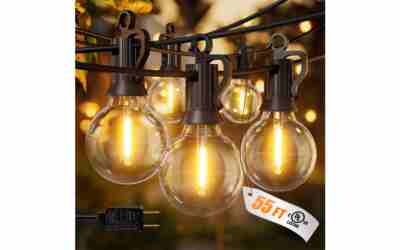
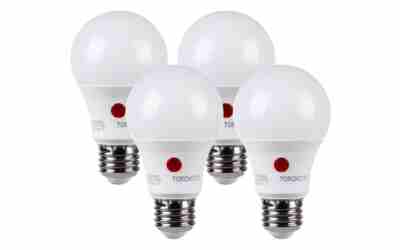
Most LED outdoor fixtures need only 3 to 15 watts, and the right number depends on the brightness (lumens) you want, not the wattage printed on the box. Path lights need about 50–200 lumens, while security floods need 700–1,500. This guide gives you the numbers, a transformer sizing example and a cost formula.
Watts for outdoor lighting by location
Older guides list 15–80 W per fixture because they assume incandescent or halogen bulbs. With LEDs, you get the same light for far fewer watts. Use lumens as your target, then read the LED wattage off the package. The table below uses roughly 80–100 lumens per watt, a common range for LEDs. Efficiency varies by product, so check the label.
| Location | Target brightness | Typical LED watts |
|---|---|---|
| Path or step light | 50–200 lumens | 1–4 W |
| Garden accent or small uplight | 100–300 lumens | 2–5 W |
| Front door or porch | 400–800 lumens | 5–10 W |
| Patio or deck (per fixture) | 300–800 lumens | 4–10 W |
| Driveway or small yard flood | 700–1,500 lumens | 8–18 W |
| Motion-sensor security light | 700–1,500 lumens | 8–18 W |
| Large yard, parking-style area | 2,000+ lumens | 20–30 W or more |
These are planning ranges, not code requirements. Your layout, tree cover and how dark your street is all change what feels right. For warm, residential light, choose bulbs around 2700–3000K.
How do watts convert to lumens for LED and incandescent bulbs?
Lumens measure light output. Watts measure the power a bulb draws. An LED turns far more of that power into light, so a low-watt LED can replace a high-watt incandescent. The equivalents below are typical figures for standard bulbs. Individual products differ, so trust the lumens on the package.
| Light output | Old incandescent | Halogen (approx.) | LED (approx.) |
|---|---|---|---|
| 450 lumens | 40 W | 28–30 W | 4–6 W |
| 800 lumens | 60 W | 40–43 W | 8–10 W |
| 1,100 lumens | 75 W | 53 W | 10–13 W |
| 1,600 lumens | 100 W | 72 W | 14–20 W |
So a 100-watt-equivalent LED usually draws somewhere around 14–20 W, though some products with lower efficiency draw more. One retailer example lists a 23 W LED matching a 100 W incandescent, which shows how much the range can vary.
Decision rule: pick the lumens first, then buy the lowest-wattage LED that delivers them in the color temperature you want. Never exceed the maximum wattage printed on an older fixture. With LEDs, you will be far below it.
How do I size a low-voltage landscape lighting transformer?
Add up the watts of every fixture on the system, then choose a transformer rated comfortably above that total. A common rule of thumb is to leave 20–25% headroom, but check your transformer manufacturer’s instructions, since some set their own limit.
Worked example
- 10 path lights at 3 W = 30 W
- 4 spotlights at 7 W = 28 W
- 2 wall washers at 10 W = 20 W
- Total load: 78 W
To keep the load at or below 80% of the rating, divide by 0.8: 78 ÷ 0.8 = 97.5 W. A 100 W transformer technically covers it, but with almost no room to grow. A 150 W unit gives space for more fixtures later. If a fixture lists VA instead of watts, treat the two as roughly equal for planning, and follow the product’s documentation.
Many transformers offer taps such as 12, 13, 14 or 15 V. Higher taps help make up for voltage lost along long wire runs. Our landscape lighting transformer roundup compares options, and the DEWENWILS outdoor low voltage transformer review covers one common model.
How do wire gauge and run length affect voltage drop?
Low-voltage wire loses voltage as it gets longer and as more watts flow through it. The farther a fixture sits from the transformer, the dimmer it gets, and the last fixture on the run suffers most. A common estimate is:
End-of-run voltage = tap voltage − (total watts × wire length ÷ wire constant)
The wire constant depends on the gauge and the manufacturer’s chart, so take it from the transformer or cable instructions rather than a generic number. Thicker wire (a lower gauge number, such as 12 AWG versus 16 AWG) loses less voltage over the same distance.
To reduce voltage drop:
- Use thicker cable for long runs or heavy loads.
- Split the system into two or more shorter runs from the transformer instead of one long daisy chain.
- Place the transformer near the middle of the layout.
- Use a higher tap, such as 15 V, if the fixtures tolerate it. Check their rated voltage range.
- Keep the load per run well under the cable’s limit in the manufacturer’s chart.
Symptoms of too much drop include dim or yellowish lights at the far end and LEDs that flicker.
How many watts can one circuit or string-light run handle?
A standard 15-amp, 120-volt circuit supplies 1,800 W at most (15 × 120). Keep continuous loads, such as lights that stay on for hours, under 80% of that, which is 1,440 W. A 20-amp circuit works out to 2,400 W, or 1,920 W continuous. Your breaker size and wiring decide the real limit, and the circuit may share other outlets.
A transformer’s input draw is small compared with these limits. Even a 300 W transformer is a fraction of a 15-amp circuit, but anything else on that circuit counts too.
String lights have their own limit, which is printed on the box or the plug: the maximum number of strands you can connect end to end, or the maximum total watts. It varies by model. Incandescent-style bulbs draw more per bulb than LED bulbs, so an incandescent set such as the Brightech Ambience Pro hits connection limits sooner than an LED set. LED options include the addlon G40 string lights and the Brightever outdoor string lights. Check each product’s label for its connection limit.
Outdoor outlets should be GFCI-protected. For new line-voltage (120 V) wiring, hire a licensed electrician, since permits and local code often apply.
How much does it cost to run outdoor lights per month?
Use this formula with your own electric rate, which is on your utility bill in dollars per kilowatt-hour (kWh):
Monthly cost = (total watts × hours per night × 30 ÷ 1,000) × your rate per kWh
Using the 78 W system from above, running 6 hours a night:
- 78 W × 6 hours = 468 watt-hours per night
- 468 × 30 nights = 14,040 Wh, or about 14 kWh per month
- 14 kWh × your rate = your monthly cost
As an illustration only, at a rate of $0.20 per kWh that would be about $2.80 a month. Your rate will differ.
Motion-sensor lights use less energy because they stay at full brightness only when triggered, though they draw a small standby load. If you want a floodlight that stays off most of the night, see our motion sensor outdoor lights roundup. Timers and dusk-to-dawn sensors also cut hours without extra wattage.
Common mistakes and safety checks
- Buying by watts. Two 10 W LEDs can differ in brightness. Compare lumens.
- Maxing out the transformer. Overloading causes overheating and shortens its life. Leave headroom.
- Ignoring voltage drop. A correct total wattage still gives dim lights if the run is long and the wire is thin.
- Too much glare. Flood lights above 1,500 lumens aimed at a yard can shine into neighbors’ windows. Aim downward and use shielded fixtures.
- Wrong fixture rating. Use products rated for wet or damp locations, and follow the maximum wattage on each fixture.
- Skipping power-off. Turn off the breaker before touching any line-voltage wiring. Call an electrician if you are unsure.
- Burial depth. Low-voltage cable is usually buried shallower than line-voltage cable, but check the product instructions and local code.
Our Top Picks
Ready to shop? These are the top-rated options from our hands-on roundup, Best Landscape Lighting Transformer of 2026.

Treewell 300W Low Voltage Landscape Transformer

DEWENWILS 300W Low Voltage Transformer Photocell Timer

SUNVIE 300W Low Voltage Transformer with 3 Zone
As an Amazon Associate we earn from qualifying purchases. Product prices and availability are accurate as of the date/time indicated.
Frequently Asked Questions
How many watts is a good outdoor flood light?
For an LED flood light, about 8–18 W typically delivers 700–1,500 lumens, enough for a driveway or small yard. Efficiency varies by product, so check the lumens on the package rather than relying on watts alone.
How many lumens do I need for outdoor lighting?
Path lights usually work at 50–200 lumens, doors and patios at 300–800, and motion or security lights at 700–1,500. Go lower in dark, quiet areas and avoid glare toward neighbors.
How many watts is a 100-watt equivalent LED?
A 100-watt-equivalent LED produces about 1,600 lumens and typically draws around 14–20 W. Some products draw more, so confirm the lumens and watts listed on the package.
Do LED lights need a smaller transformer?
Yes. LED fixtures draw far fewer watts, so a smaller transformer often works. Add up the fixture watts, leave headroom as the manufacturer recommends, and account for voltage drop on long wire runs.
{“@context”: “https://schema.org”, “@type”: “FAQPage”, “mainEntity”: [{“@type”: “Question”, “name”: “How many watts is a good outdoor flood light?”, “acceptedAnswer”: {“@type”: “Answer”, “text”: “For an LED flood light, about 8–18 W typically delivers 700–1,500 lumens, enough for a driveway or small yard. Efficiency varies by product, so check the lumens on the package rather than relying on watts alone.”}}, {“@type”: “Question”, “name”: “How many lumens do I need for outdoor lighting?”, “acceptedAnswer”: {“@type”: “Answer”, “text”: “Path lights usually work at 50–200 lumens, doors and patios at 300–800, and motion or security lights at 700–1,500. Go lower in dark, quiet areas and avoid glare toward neighbors.”}}, {“@type”: “Question”, “name”: “How many watts is a 100-watt equivalent LED?”, “acceptedAnswer”: {“@type”: “Answer”, “text”: “A 100-watt-equivalent LED produces about 1,600 lumens and typically draws around 14–20 W. Some products draw more, so confirm the lumens and watts listed on the package.”}}, {“@type”: “Question”, “name”: “Do LED lights need a smaller transformer?”, “acceptedAnswer”: {“@type”: “Answer”, “text”: “Yes. LED fixtures draw far fewer watts, so a smaller transformer often works. Add up the fixture watts, leave headroom as the manufacturer recommends, and account for voltage drop on long wire runs.”}}]}