Here is how to choose a lawn mower: match the type to your yard size and terrain first. Small flat lawns suit push or manual mowers, bigger or sloped yards suit self-propelled models, and anything above roughly an acre usually calls for a rider. Then decide on power source, cut width, and features.
Start with your yard size
Yard size narrows your options faster than any other factor. Measure the mowable area (length times width in feet, subtracting beds and patios), then divide by 43,560 to get acres. A 100 ft by 80 ft lawn is 8,000 square feet, or about 0.18 acre.
| Mowable lawn size | Typical fit |
|---|---|
| Under 5,000 sq ft | Manual reel, corded electric, or compact battery push mower |
| 5,000 to 10,000 sq ft | Battery push, gas push, or entry self-propelled |
| 10,000 to 20,000 sq ft | Self-propelled gas or higher-capacity battery mower; robotic mowers also work |
| 1/2 to 1 acre | Wide gas self-propelled walk-behind or a small riding mower |
| Over 1 acre | Riding mower or zero-turn |
These are rules of thumb. Real-world coverage depends on the model, battery capacity, grass thickness, and how often you mow, so check the manufacturer’s stated runtime or area rating.
Pick a power source
Power type affects noise, upkeep, and how much you can mow in one go.
Battery (cordless)
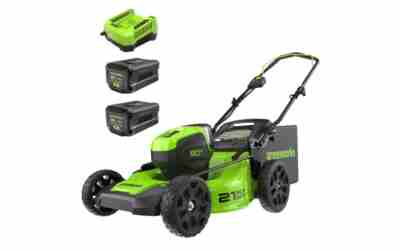
Battery mowers start with a button, are much quieter than gas, and need no oil or fuel. Runtime varies widely by model, from roughly 30 to 60 minutes on a single battery for many mid-range units. Larger yards often need a second battery or a model that holds two. If you are leaning this way, see our picks for cordless electric lawn mowers.
Gas
Gas mowers deliver steady power for thick, tall, or large lawns and refuel in a minute. The tradeoffs are noise, exhaust, and maintenance: oil changes, spark plug, air filter, and fresh fuel. Old ethanol-blend gasoline left in the tank over winter is a common cause of hard starting.
Corded electric
Corded mowers are the cheapest to run and never run out of charge, but you manage a cord, typically 100 to 150 ft of outdoor-rated extension cord at most. They suit small, simple lawns without many obstacles.
Manual reel
A reel mower has no motor, makes almost no noise, and gives a clean scissor cut. It works best on small, level lawns where you mow often, and it struggles with tall, weedy, or sticky grass.
Robotic
Robotic mowers cut a little every day within a boundary wire or a mapped area. They need a fairly open lawn and some setup, and they do not replace a regular mower for edges or overgrown grass.
Push or self-propelled
A push mower relies on you to move it. A self-propelled mower drives its own wheels, and you control the speed. For flat lawns under about a quarter acre, a push mower is usually enough and costs less. Our roundup of push lawn mowers covers that route.
Self-propelled models make sense when you have any of these:
- A lawn larger than about a quarter acre
- Slopes or uneven ground
- Thick grass or frequent bagging, which makes the mower heavy
- Strength or joint concerns that make pushing tiring
Look at the drive type. Rear-wheel drive gives better traction on hills and when the bag is full. Front-wheel drive turns more easily on flat ground. All-wheel drive helps on mixed terrain but usually costs more. For more options, see our guide to self-propelled lawn mowers.
Account for slopes and terrain
Hills change the safety picture. Most manufacturers publish a maximum slope for each mower, often around 15 degrees for walk-behind models and lower for many riders. Your owner’s manual is the authority, so check it before buying for a steep yard.
- Walk-behind mowers: mow across a slope, not up and down, so a slip does not carry the mower toward you.
- Riding mowers: mow up and down a slope rather than across it, to reduce tip-over risk.
- Very steep or rough areas: if the grade feels unsafe to walk, it is too steep to mow with a typical mower. Consider a different ground cover or a professional.
Traction matters on slopes, so look for rear-wheel or all-wheel drive and wheels with deep tread. Our list of lawn mowers for hills focuses on those traits.
Check cut width, height range, and deck features
Cut width. Most walk-behind mowers cut 19 to 22 inches. A wider deck, such as 30 inches, means fewer passes on a big lawn but is harder to fit through gates and around landscaping. Measure your narrowest gate before you shop.
Cutting height. Most cool-season lawns, such as fescue, bluegrass, and ryegrass, do best at about 3 to 4 inches. Warm-season grasses such as Bermuda and zoysia are often kept much shorter, around 1 to 2.5 inches. Not every rotary mower goes that low, so check the minimum deck height if you have warm-season turf.
Mulch, bag, or side discharge. A 3-in-1 mower covers all three. Mulching returns fine clippings to the lawn and works well when you mow regularly and never remove more than about one-third of the blade height at a time. Bagging is better for tall grass, weed seed, or lawn disease.
Handy extras. One-lever height adjustment, foldable handles for storage, a large rear bag, and a washout port for the deck all make owning a mower easier.
Think about storage and upkeep before you buy
The cheapest mower is not always the least expensive to own. Gas models need fuel, oil, filters, and blade sharpening. Battery models mostly need blade care and proper battery storage. Whatever you choose, sharpen or replace the blade at least once a season, since a dull blade tears grass and leaves brown tips.
Storage space counts too. Foldable-handle and upright-storage battery mowers can fit in a small closet or against a garage wall. If you go battery, plan for the off-season: batteries should be stored at a partial charge in a cool, dry place per the manufacturer’s directions. Our guide on how to winterize a battery lawn mower walks through it.
Common mistakes to avoid:
- Buying for the biggest lawn you might ever have, instead of the one you have now
- Ignoring slope and gate width until the mower arrives
- Picking a battery mower with too little runtime for your lawn
- Skipping the warranty and service check: confirm there is a repair shop or support nearby, and read what the warranty covers for residential use
Prices and specs change by model and retailer, so compare current numbers before purchase rather than relying on a general range.
Frequently Asked Questions
What size lawn mower do I need for a half-acre yard?
For about half an acre, a wide self-propelled gas mower or a high-capacity battery mower with two batteries can work, though mowing takes a while. Many owners at this size move to a small riding mower. Check the stated runtime or area rating for your model.
Is a battery or gas lawn mower better?
Battery mowers are quieter, easier to start, and need less maintenance, which suits small to medium lawns. Gas mowers offer longer run time and steady power for large or thick lawns. The better choice depends on your yard size and how much upkeep you accept.
Do I need a self-propelled mower?
You likely do if your lawn is over about a quarter acre, has slopes, or has thick grass that makes a push mower heavy. On small, flat lawns, a regular push mower is usually enough and costs less.
What mower is best for Bermuda grass?
Bermuda is usually mowed short, often 1 to 2 inches, so look for a mower with a low minimum deck height and sharp blades. Reel mowers give a very clean cut, while many rotary mowers also work. Check each model’s lowest setting.