
The right size transformer for outdoor lighting is your total fixture wattage times 1.25, so the load stays at or below 80% of the transformer’s rating. For a typical 12-volt LED yard that usually means a 100 W or 150 W unit; halogen setups often need 300 W or more.
How to size a transformer for outdoor lighting in 3 steps
- List every fixture’s wattage. Use the number printed on the fixture, bulb or packaging. LED fixtures often use 2 to 8 W each, while halogen fixtures often use 20 W or more. Wattage varies by model, so read your labels. Our guide to how many watts outdoor lighting uses helps if you are still choosing fixtures.
- Add them up. That is your total load in watts.
- Multiply by 1.25. This keeps the load at or below 80% of the rating, a common rule of thumb for continuous use. Round up to the next standard size.
Add the wattage of any fixtures you plan to install later before you multiply. Adding a transformer later costs more than buying one size up today.
Most landscape systems run at 12 V. The transformer steps 120 V household power down to 12 V, so the rating on the label is the number to size against.
Worked example: LED vs. halogen on the same yard
Say your plan is 12 path lights, 6 spotlights and 2 wall lights.
| Step | LED | Halogen |
|---|---|---|
| Path lights (12) | 12 x 3 W = 36 W | 12 x 20 W = 240 W |
| Spotlights (6) | 6 x 5 W = 30 W | 6 x 35 W = 210 W |
| Wall lights (2) | 2 x 8 W = 16 W | 2 x 20 W = 40 W |
| Total load | 82 W | 490 W |
| Total x 1.25 | 102.5 W | 612.5 W |
| Size to buy | 150 W | 900 W |
Here is the trap: the LED total of 82 W looks like it fits a 100 W transformer. But 82 W is 82% of 100 W, which is above the 80% target. Step up to 150 W, which also leaves room to add lights later.
The halogen yard is why most people switch to LED. The same layout needs a unit about six times larger, and it costs more to run. The wattages above are example values, so use the numbers on your own fixtures.
Common transformer sizes and how many lights each runs
Landscape transformers commonly come in 100 W, 150 W, 300 W, 600 W and 900 W. The table shows the maximum load at 80% and how many 4 W LED fixtures that allows. These are estimates: rating x 0.8, then divided by 4 W.
| Rating | Max load at 80% | 4 W LED fixtures |
|---|---|---|
| 100 W | 80 W | 20 |
| 150 W | 120 W | 30 |
| 300 W | 240 W | 60 |
| 600 W | 480 W | 120 |
| 900 W | 720 W | 180 |
So a 300 W transformer runs about 60 fixtures at 4 W each, or twelve 20 W halogen fixtures. In practice, wire length and run layout limit you before the wattage does.
If you want specific units to compare, see our roundup of the best landscape lighting transformers.
Does wire gauge and run length change the transformer size?
Not the wattage rating, but it changes whether your lights get enough voltage. Over a long run, the wire loses voltage and the last lights dim. A drop of about 10% (1.2 V on a 12 V system) is a common limit before dimming becomes noticeable.
This table estimates the longest one-way run at a 1.2 V drop with the whole load at the far end. Method: copper wire resistance, doubled for the round trip, at 12 V. Fixtures spread along the run allow somewhat longer lengths.
| Wire | 50 W load | 100 W load |
|---|---|---|
| 14 AWG | about 57 ft | about 28 ft |
| 12 AWG | about 90 ft | about 45 ft |
| 10 AWG | about 144 ft | about 72 ft |
Practical fixes for dim lights at the end of a run:
- Use thicker wire (a lower AWG number).
- Split the lights into shorter runs from the transformer.
- Connect to a higher voltage tap, if your transformer has one.
- Place the transformer near the middle of the yard instead of at one end.
Multiple runs, taps and when to use two transformers
You can connect more than one run of wire to a single transformer, as long as the combined load of all runs stays under 80% of its rating. Each run connects to the same terminals, or to different taps.
Many transformers have several taps, such as 12 V, 13 V, 14 V and 15 V. Use a higher tap for a long run and a lower tap for a short one. Test with a voltmeter at the last fixture and aim for roughly 10.5 to 12 V there. Check your manual for the right range for your fixtures.
Use a second transformer when:
- The total load passes the biggest unit you want to buy.
- Two areas of the yard are far apart, such as front and back.
- Even thick wire cannot keep the farthest run bright.
Our zone-by-zone outdoor lighting guide shows how to divide a yard into areas that suit separate runs.
What happens if the transformer is too small or too big?
Too small: the transformer runs hot, voltage sags and lights dim. It may trip its breaker or shut off, and a chronically overloaded unit is a heat and fire risk.
Too big: this is safe. You pay more up front, and the unit simply runs below capacity. Some electronic units want a minimum load, so check the label if you only run a few small LEDs.
Also check whether the label shows watts or VA. They are close for these loads, but size against the watt rating if both are listed.
Magnetic vs. electronic, timers and safety
Magnetic transformers use a copper coil. They are sturdy, handle loads well and suit large halogen or mixed systems. Electronic (digital) units are lighter, often more efficient and common in LED kits. Either type works if the rating matches your load.
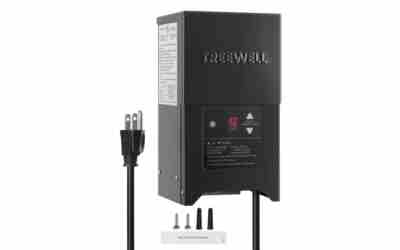
Look for a built-in timer or photocell so lights switch on at dusk without a separate controller. A unit with a timer and several taps is a flexible choice for a growing yard. For a single-model look, see our DEWENWILS outdoor low voltage transformer review.
Safety basics: plug into a GFCI-protected outdoor outlet with a weatherproof in-use cover, and turn power off before wiring. Mount the transformer at the height the manual specifies, away from standing water. Use cable rated for outdoor or direct burial. Hardwiring the 120 V side falls under the NEC and local code, so hire a licensed electrician for it.
Frequently Asked Questions
How many lights can I run on a 300 W transformer?
At the 80% target, a 300 W transformer carries 240 W. That is about 60 LED fixtures at 4 W each, or twelve 20 W halogen fixtures. Wire length and voltage drop may limit you sooner, so split large layouts into several runs.
Can I use a bigger transformer than my lights need?
Yes. A larger transformer is safe and gives room to add fixtures later. It costs more up front. Some electronic units need a minimum load to work properly, so check the label if you only run a few small LEDs.
Do solar or line-voltage lights need a landscape transformer?
Solar lights do not, since each has its own panel and battery. Line-voltage (120 V) fixtures plug in or are hardwired directly and must not be connected to a 12 V transformer. Only 12 V low-voltage fixtures use one.
Can I reuse my old halogen transformer after switching to LED?
Often yes, since the load drops sharply. Check the label for a minimum load and for LED compatibility, especially on electronic units. Magnetic transformers are generally more tolerant. If lights flicker or dim oddly, a unit rated for LED is the fix.
{“@context”: “https://schema.org”, “@type”: “FAQPage”, “mainEntity”: [{“@type”: “Question”, “name”: “How many lights can I run on a 300 W transformer?”, “acceptedAnswer”: {“@type”: “Answer”, “text”: “At the 80% target, a 300 W transformer carries 240 W. That is about 60 LED fixtures at 4 W each, or twelve 20 W halogen fixtures. Wire length and voltage drop may limit you sooner, so split large layouts into several runs.”}}, {“@type”: “Question”, “name”: “Can I use a bigger transformer than my lights need?”, “acceptedAnswer”: {“@type”: “Answer”, “text”: “Yes. A larger transformer is safe and gives room to add fixtures later. It costs more up front. Some electronic units need a minimum load to work properly, so check the label if you only run a few small LEDs.”}}, {“@type”: “Question”, “name”: “Do solar or line-voltage lights need a landscape transformer?”, “acceptedAnswer”: {“@type”: “Answer”, “text”: “Solar lights do not, since each has its own panel and battery. Line-voltage (120 V) fixtures plug in or are hardwired directly and must not be connected to a 12 V transformer. Only 12 V low-voltage fixtures use one.”}}, {“@type”: “Question”, “name”: “Can I reuse my old halogen transformer after switching to LED?”, “acceptedAnswer”: {“@type”: “Answer”, “text”: “Often yes, since the load drops sharply. Check the label for a minimum load and for LED compatibility, especially on electronic units. Magnetic transformers are generally more tolerant. If lights flicker or dim oddly, a unit rated for LED is the fix.”}}]}