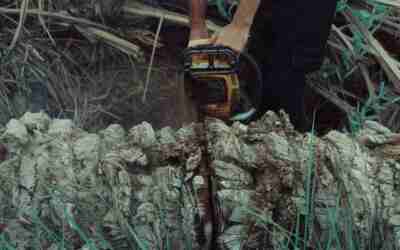
A chainsaw cuts crooked when the cutters on one side are longer or sharper than the other, the bar is worn or bent, or you are pushing the saw instead of letting it cut. Check those three things in that order and you will find the cause in about five minutes, usually without any special tools.
Which way does it pull? Read the cut first
Make one shallow cut in a clean log and note which way the saw drifts. Direction narrows the cause before you touch the chain.
| What you see | Most likely cause | First check |
|---|---|---|
| Cut curves toward one side every time | Cutters on that side are sharper or longer | Compare left and right cutter length |
| Cut curves, and the saw bounces or chatters | Depth gauges uneven side to side | Check gauge height on both sides |
| Cut drifts toward one side even with a freshly sharpened chain | Bar rail worn lower on that side | Straightedge on the bar rails |
| Chain wobbles or flops sideways in the bar | Wrong chain gauge or widened bar groove | Chain gauge vs. groove width |
| Cut wanders only when you lean on the saw | Technique, forcing the cut | Let the weight of the saw do the work |
The rule of thumb: the saw pulls toward the side that cuts more aggressively. A rock strike or dirt can leave one side sharp and the other dull, which is why a chain can go bad after a single cut.
What your sawdust says about a crooked cut
A healthy, sharp chain throws medium to long chips of even size from both sides of the cut. Watch the pile while you cut.
- Fine powder: The cutters are dull or the depth gauges are too high, so the chain scrapes instead of slicing. Dull chains also push you to force the saw.
- Big, thick chips and a grabby saw: Depth gauges are too low, so the cutters bite too deep and the saw can pull hard to one side.
- Chips from one side, dust from the other: One row of cutters is sharp and the other is dull or shorter. This is the classic crooked-cut pattern.
- Smoke, burn marks or blue discoloration on the bar: The chain is dull, too tight, or short on bar oil.
Uneven output on the two sides tells you to compare the cutters before anything else.
Flip-and-compare test for cutters and depth gauges
Safety first: Shut the saw off, let it cool, and engage the chain brake. Remove the spark plug wire or battery before working on it. Wear cut-resistant gloves and eye protection, because chain edges stay sharp even when the saw is off.
- Look at both rows. Rotate the chain by hand and compare left-hand and right-hand cutters. Look for chipped, rolled, or blue-burned tips and teeth that are visibly shorter.
- Measure cutter length. Use basic calipers (often about $5 to $10) and measure each top plate from the front edge to the back. Mark the shortest cutter. As a rule of thumb, keep every cutter within about 1/64 inch of the shortest one.
- Compare the two sides. If all left cutters are shorter than the right (or the reverse), the saw will lean toward the longer, sharper side.
- Check depth gauges. These are the small humps in front of each cutter. Many chains call for roughly .025 inch below the cutter, but the exact figure depends on your chain, so follow the chain maker’s spec. What matters most is that left and right match.
Counting file strokes instead of measuring is a common reason cutters and gauges drift out of balance over time. File each tooth until it is clean and matches the shortest one, not a set number of strokes.
Check the bar and chain fit
If the cutters match and the saw still drifts, look at the bar and how the chain sits on it.
Straightedge test for rail wear
Remove the bar and lay a straightedge across both rails near the middle. Light showing under one rail means that rail is worn lower, and the cut will drift toward the worn side. Flipping the bar each time you sharpen spreads the wear.
Burrs and a widened groove
Run a gloved finger along the rail edges. A raised burr can be dressed with a flat file. Clean the groove with a scraper too, since packed sawdust and sludge push the chain off line. If the chain rocks sideways in the groove or sits down on the bottom, the groove is worn wide and the bar needs replacing.
Gauge and pitch must match the bar
A chain with the wrong gauge (drive link thickness) will sit loosely, wobble, and cut crooked. If you are not sure what you have, read our guide on how to size a chainsaw chain by pitch, gauge, and link count.
Tension
A correct chain is snug against the bar but still pulls around by hand. Too loose lets it twist and wander. Too tight overheats the bar and speeds rail wear. Set it with the nuts loosened, then retighten, and follow your manual because procedures vary by saw. Recheck after the first few cuts on a new chain, since it stretches.
What to do when your chainsaw cuts crooked
Work in this order, from cheapest to most expensive.
- Clean and retension. Clear the groove and oiler hole, then reset tension.
- Re-file to the shortest cutter. Use a round file of the right diameter and a file guide, and hold the same angle on every tooth. Our walkthrough on how to sharpen a chainsaw chain by hand covers filing angle and depth gauge setting step by step.
- Reset depth gauges. Use a depth gauge tool and a flat file to match both sides to your chain’s spec.
- Dress the bar. File off burrs and flip the bar to even out wear.
- Replace the chain if it is cracked, has broken or heavily damaged cutters, or is too short to file evenly. If you are shopping, our roundup of the best chainsaw chain brands can help you pick a quality chain.
- Replace the bar if the rails fail the straightedge test by a visible gap or the groove is too wide to hold the chain.
A new chain can still cut crooked if it is on a worn bar, has the wrong gauge, or was filed unevenly at the factory edge by earlier sharpening. Always put a new chain on a bar you have checked.
Technique habits that keep cuts straight, and how often to sharpen
Even a perfect chain will wander if you lean on it. Never force a crooked cut. A pinched or binding bar can kick back, so stop, back out, and recheck the saw.
- Let the saw do the work. Use light pressure on the handles and let the chain pull itself in. If you have to push, the chain is dull.
- Seat the bumper spikes (dogs). Press them into the wood and pivot the saw around them rather than shoving the bar sideways.
- Keep the bar level and square to your line. Marking the cut with a visible line helps.
- Relieve pressure at the end. Do not twist the bar in the cut.
- Don’t cut dirty wood. Soil and grit dull the cutters quickly.
There is no fixed schedule for sharpening. Touch up with a few file strokes at every fuel or battery stop, and re-sharpen sooner when you cut dirty, frozen, or very hard wood, or when the sawdust turns to powder. After a rock strike, stop and fix the chain right away. Every few sharpenings, measure the cutters again and reset the depth gauges.
Our Top Picks
Ready to shop? These are the top-rated options from our hands-on roundup, Best Chainsaw Chain of 2026.

EGO POWER+ CS1613 16-Inch Cordless Chainsaw with 56V 4.0Ah ARC Lithium Battery and Brushless Motor

Oregon CS1500 18-Inch Self-Sharpening Corded Electric Chainsaw, 15 Amp High-Power Motor

EGO POWER+ CS1611 16-Inch 56V Cordless Chainsaw with 2.5Ah Battery and Charger
As an Amazon Associate we earn from qualifying purchases. Product prices and availability are accurate as of the date/time indicated.
Frequently Asked Questions
Can a brand-new chain still cut crooked?
Yes. A new chain on a worn or bent bar, a widened groove, or the wrong gauge will still wander. Loose tension and leaning on the saw can also cause it. Check the bar rails with a straightedge before blaming the chain.
Does the saw cut toward the sharp side or the dull side?
As a rule of thumb, it pulls toward the side that cuts more aggressively, meaning the sharper or longer cutters. Filing every cutter down to match the shortest one on the dull side is the usual fix.
Is it worth fixing a worn bar instead of replacing it?
Light burrs and minor rail unevenness can be dressed with a flat file. If the straightedge shows a clear gap or the chain sits loose in the groove, replacement is the safer choice, since filing cannot restore a widened groove.
Can too much chain tension make a saw cut crooked?
It can contribute. An over-tight chain heats the bar and wears the rails unevenly, while a loose one twists in the cut. Aim for snug but still free to pull by hand, and follow your saw’s manual.
{“@context”: “https://schema.org”, “@type”: “FAQPage”, “mainEntity”: [{“@type”: “Question”, “name”: “Can a brand-new chain still cut crooked?”, “acceptedAnswer”: {“@type”: “Answer”, “text”: “Yes. A new chain on a worn or bent bar, a widened groove, or the wrong gauge will still wander. Loose tension and leaning on the saw can also cause it. Check the bar rails with a straightedge before blaming the chain.”}}, {“@type”: “Question”, “name”: “Does the saw cut toward the sharp side or the dull side?”, “acceptedAnswer”: {“@type”: “Answer”, “text”: “As a rule of thumb, it pulls toward the side that cuts more aggressively, meaning the sharper or longer cutters. Filing every cutter down to match the shortest one on the dull side is the usual fix.”}}, {“@type”: “Question”, “name”: “Is it worth fixing a worn bar instead of replacing it?”, “acceptedAnswer”: {“@type”: “Answer”, “text”: “Light burrs and minor rail unevenness can be dressed with a flat file. If the straightedge shows a clear gap or the chain sits loose in the groove, replacement is the safer choice, since filing cannot restore a widened groove.”}}, {“@type”: “Question”, “name”: “Can too much chain tension make a saw cut crooked?”, “acceptedAnswer”: {“@type”: “Answer”, “text”: “It can contribute. An over-tight chain heats the bar and wears the rails unevenly, while a loose one twists in the cut. Aim for snug but still free to pull by hand, and follow your saw’s manual.”}}]}