For most homes, a 5/8-inch inside diameter and 50 feet is the answer to what size garden hose to buy. Choose 3/4-inch if your run is 100 feet or more, you feed big sprinklers, or you fill large tanks. Choose 1/2-inch only for light patio use. Your spigot limits flow too, so test it first.
What size garden hose to buy: 5/8 or 3/4 inch?
Buy a 5/8-inch hose unless you have a reason not to. It is the most common size, it weighs less than 3/4-inch, and it handles most sprinklers and watering wands. The size on the package is the inside diameter, not the outside.
Step up to 3/4-inch when the run is long or you need high volume. Drop to 1/2-inch only when light weight and easy storage matter more than flow.
| Size (inside diameter) | Choose it if | Trade-off |
|---|---|---|
| 1/2 inch | Patio, balcony, containers, runs under 25 ft, or you have trouble handling heavy hoses | Lowest flow, and pressure drops fastest with distance |
| 5/8 inch | Typical yard, runs up to about 75 ft, one sprinkler, hand watering, car washing | Fills big tanks more slowly than 3/4-inch |
| 3/4 inch | Runs of 100 ft or more, large sprinklers, filling pools or stock tanks, two outlets at once | Heavier, stiffer and usually costs more; your spigot may be the real limit |
Bigger is not automatically better. If your spigot delivers only a modest flow, a 3/4-inch hose mostly gives you a heavier hose. Run the bucket test below before you pay for the extra size.
How much flow do you lose at each hose diameter?
Wider hoses lose less pressure over the same distance. The table shows typical flow figures and an estimated pressure loss per 50 feet of hose.
| Diameter | Typical flow, 50 ft, 40-60 psi | Est. loss per 50 ft at 5 GPM | Est. loss per 50 ft at 10 GPM |
|---|---|---|---|
| 1/2 inch | about 5-9 GPM | about 12 psi | Not realistic at this length |
| 5/8 inch | about 9-17 GPM | about 4 psi | about 15 psi |
| 3/4 inch | about 15-25 GPM | about 2 psi | about 6 psi |
The flow ranges come from typical published guides and vary by hose model, spigot and home water pressure. Some manufacturer tests report higher numbers: Lee Valley lists about 30 GPM for a 50 ft 3/4-inch hose and about 23 GPM for 5/8-inch at 60 psi. The loss figures are estimates from the standard Hazen-Williams friction-loss formula for a smooth hose. Real hoses with kinks, couplings and nozzles lose more.
Worked example: One sprinkler using about 5 GPM on 50 ft of 5/8-inch hose loses roughly 4 psi, which you will not notice on 50 psi household pressure. Run 10 GPM through 100 ft of the same hose and the loss is roughly 30 psi, leaving about 20 psi at the end. That is where 3/4-inch pays off: the same run loses roughly 12 psi.
Loss grows in proportion to length, so doubling the hose roughly doubles the drop. Ignore online charts claiming 40+ GPM through a 5/8-inch hose. They show theoretical numbers that a house spigot cannot deliver.
How can you test your own flow with a 5-gallon bucket?
Your spigot and house plumbing cap how much water any hose can carry. This test takes five minutes and needs no tools.
- Disconnect all hoses and timers. Open the spigot fully.
- Time how long it takes to fill a 5-gallon bucket.
- Divide 300 by the seconds. A 30-second fill is 10 GPM, a 20-second fill is 15 GPM and a 60-second fill is 5 GPM.
- Attach the hose you own, open the nozzle fully and repeat at the far end.
If the second result is close to the first, your current hose is fine and a bigger one will not help. If the hose end gives far less, you have a hose-size or length problem. If the bare spigot only reaches about 8 GPM, a 5/8-inch hose carries all of it, and 3/4-inch buys very little.
Most homes run 40 to 60 psi. A cheap screw-on pressure gauge at the spigot confirms yours. Pressure over 80 psi usually calls for a regulator, so check your local plumbing code.
What length garden hose do you need?
Buy the shortest hose that reaches your farthest point with about 5 feet of slack. Standard lengths are 25, 50, 75 and 100 feet. A 25 ft hose suits patios and balconies, and 50 ft covers many medium yards.
How to measure the run
- Pull a string or tape from the spigot to the farthest spot you water.
- Follow the actual route: around corners, beds and the garage, not a straight line.
- Add 10% for curves, plus 5 ft of slack.
Example: The back fence is 62 ft in a straight line. Routed around the house corner, it measures 66 ft. Add 10% (about 7 ft) and 5 ft of slack, and you get 78 ft, so buy a 75 ft hose and plan a short step toward the fence, or choose 100 ft if you want comfortable slack.
Common mistake: buying too long. Extra length adds weight and pressure loss, and the excess coils up and kinks. A full hose also holds water. A 50 ft run holds about 0.8 gallons (about 6.7 lb of water) in 5/8-inch and about 1.15 gallons (about 9.6 lb) in 3/4-inch, before the hose itself, which varies by model. Lift with your legs and drain it before carrying.
Joining two short hoses works, but each coupling can leak and adds friction. If you have a long run and a reel, our guide to garden hoses that work well on a hose reel covers what fits.
Which hose material suits sun, freezing winters and drinking water?
| Material | Best for | Watch for |
|---|---|---|
| Vinyl | Light use, mild climates, small budgets | Stiffens in cold, kinks more easily, can crack from UV over time |
| Rubber | Hot sun, cold weather, heavy daily use | Heavier and often costlier |
| Hybrid (polymer or rubber-vinyl blend) | A middle ground of weight and flexibility | Quality varies a lot by model; check the maker’s temperature and pressure ratings |
For heavy use, look at our roundup of heavy-duty garden hoses. If kinking drives you crazy, see the best non-kink garden hoses. Brass couplings usually outlast plastic ones.
Drinking water: Use a hose labeled drinking water safe, lead-free or certified to NSF/ANSI 61 for pets, kids’ play and vegetable gardens. Standard vinyl hoses may not meet that standard. Our drinking-water-safe hose picks list options.
Hot sun: Water sitting in a sun-baked hose can scald. Run it until the water turns cool before use.
Freezing winters: Disconnect and drain hoses before the first hard freeze. A hose left attached can trap ice against the spigot and split the pipe inside the wall.
Do all hose sizes use the same fittings, and what about sprinklers and pressure washers?
Yes. The 1/2, 5/8 and 3/4-inch hoses all use the same 3/4-inch GHT (garden hose thread) couplings, so they screw onto the same spigots and nozzles. If you mix hose sizes, flow is limited by the narrowest section.
Adapters matter in a few cases:
- Repair ends (menders) must match the hose’s inside diameter, so a 5/8-inch mender will not fit a 1/2-inch hose. See our guide to hose ends.
- Pressure washers often use M22 or quick-connect inlets and need an adapter.
- Pipe-threaded fittings (NPT) do not thread cleanly onto garden-hose threads. Use the correct adapter.
Sprinklers: Check the sprinkler’s GPM on its label or manual. One sprinkler on 5/8-inch is fine. Two sprinklers on a splitter add their GPM together, so compare the total with your bucket-test result. If the far sprinkler barely reaches, go to 3/4-inch or shorten the run.
Pressure washers: Many consumer models need roughly 1 to 2.5 GPM at the inlet, but check your manual. A 5/8-inch supply hose usually covers it. Never connect a garden hose to the washer’s high-pressure outlet, and stay within the supply hose’s pressure rating.
Fit a backflow preventer (vacuum breaker) on the spigot so hose water cannot siphon back into household plumbing.
Quick checklist before you buy
- Run the bucket test and note your GPM.
- Measure the real route to the farthest point, then add 10% and 5 ft.
- Pick the diameter: 5/8 for most, 3/4 for 100 ft or high-flow gear.
- Pick the material for your climate and any drinking-water needs.
- Confirm brass couplings and a pressure rating that suits your use.
- Install a backflow preventer, and plan to drain the hose before winter.
Our Top Picks
Ready to shop? These are the top-rated options from our hands-on roundup, Best Garden Hoses For Hot Sun Conditions of 2026.

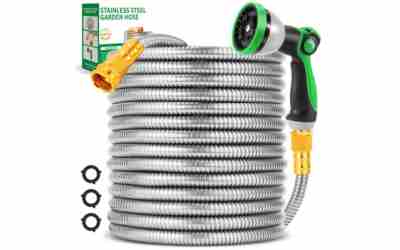
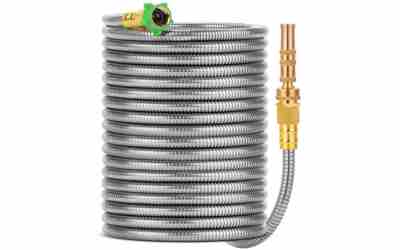
ToolasinGardenHose 50FT Stainless Steel Metal Garden Hose with 10-Function Nozzle, No-Kink and Leak-Proof Design

UNCO 75ft Stainless Steel Metal Garden Hose with 4-Function Brass Nozzle - Kink-Free Heavy Duty Design
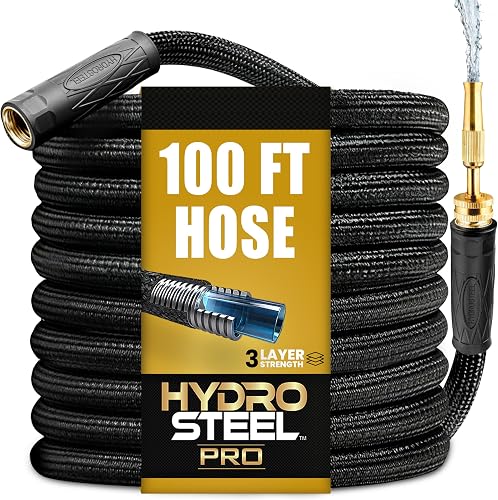
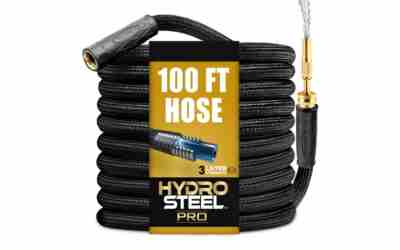
EMSON Hydrosteel PRO 100 Ft Heavy Duty 304 Stainless Steel Metal Garden Hose with Crush Resistant Fittings
As an Amazon Associate we earn from qualifying purchases. Product prices and availability are accurate as of the date/time indicated.
Frequently Asked Questions
Is a 3/4-inch hose worth it for a small yard?
Usually not. On runs under about 50 feet with one sprinkler or a hand nozzle, a 5/8-inch hose loses little pressure. A 3/4-inch hose adds weight and cost without much gain unless your spigot flows well above 15 GPM.
Does a longer hose lower water pressure at the nozzle?
Yes. Friction loss rises in proportion to length, so 100 feet loses about twice as much as 50 feet of the same hose. The effect is small at low flow and bigger at high flow.
Can I connect a 5/8-inch hose to a 3/4-inch hose?
Yes. All sizes use the same 3/4-inch GHT couplings, so they screw together. Flow is limited by the narrower hose, so you gain little by adding a wider section to the end of a 5/8-inch run.
Do I need a drinking-water-safe hose for a vegetable garden?
It is the safer choice. Standard hoses may leach chemicals into sitting water, so look for labels such as lead-free, drinking water safe or NSF/ANSI 61. Also run the hose until the water cools before watering edible plants.
{“@context”: “https://schema.org”, “@type”: “FAQPage”, “mainEntity”: [{“@type”: “Question”, “name”: “Is a 3/4-inch hose worth it for a small yard?”, “acceptedAnswer”: {“@type”: “Answer”, “text”: “Usually not. On runs under about 50 feet with one sprinkler or a hand nozzle, a 5/8-inch hose loses little pressure. A 3/4-inch hose adds weight and cost without much gain unless your spigot flows well above 15 GPM.”}}, {“@type”: “Question”, “name”: “Does a longer hose lower water pressure at the nozzle?”, “acceptedAnswer”: {“@type”: “Answer”, “text”: “Yes. Friction loss rises in proportion to length, so 100 feet loses about twice as much as 50 feet of the same hose. The effect is small at low flow and bigger at high flow.”}}, {“@type”: “Question”, “name”: “Can I connect a 5/8-inch hose to a 3/4-inch hose?”, “acceptedAnswer”: {“@type”: “Answer”, “text”: “Yes. All sizes use the same 3/4-inch GHT couplings, so they screw together. Flow is limited by the narrower hose, so you gain little by adding a wider section to the end of a 5/8-inch run.”}}, {“@type”: “Question”, “name”: “Do I need a drinking-water-safe hose for a vegetable garden?”, “acceptedAnswer”: {“@type”: “Answer”, “text”: “It is the safer choice. Standard hoses may leach chemicals into sitting water, so look for labels such as lead-free, drinking water safe or NSF/ANSI 61. Also run the hose until the water cools before watering edible plants.”}}]}