For spray vs rotor sprinklers, choose spray heads for areas narrower than about 15 feet and rotors for open lawn wider than about 20 feet. Sprays throw roughly 5 to 15 feet and put water down fast. Rotors throw roughly 25 to 50 feet and put it down slowly. Never mix the two on one zone. Here is how to decide and how to check your coverage.
Spray vs rotor sprinklers: side-by-side comparison
A spray head pushes water through a fixed nozzle in a fan shape (quarter, half or full circle). A rotor sends one or more streams that sweep across the lawn, driven by gears or an impact arm. The arc on most rotors can be adjusted from about 40 to 360 degrees.
The figures below are typical ranges from irrigation suppliers. They vary by brand, nozzle and model, so check the manufacturer’s performance chart for the heads you actually buy.
| Feature | Spray heads | Rotor heads |
|---|---|---|
| Throw radius | About 5-15 ft (up to about 18 ft with high-efficiency nozzles) | About 25-50 ft (large turf rotors go past 70 ft) |
| Typical operating pressure | About 20-30 psi, around 30 psi at the nozzle is ideal | About 40-55 psi for best results; some models list up to 65 psi |
| Precipitation rate | About 1.5-2.5 in/hr | About 0.5-0.8 in/hr |
| Typical run time | About 10-15 minutes | About 30-45 minutes |
| Arc | Fixed quarter, half or full patterns | Adjustable, about 40-360 degrees |
| Best for | Small lawns, narrow strips, irregular shapes, shrub beds | Medium to large open lawns |
The precipitation rate is the key difference. Sprays apply water roughly 3 to 4 times faster than rotors, and that drives most of the decisions below.
Which is better for my yard: spray or rotor?
Use the width of the area you need to water, not the total lot size.
- Under about 15 ft wide: spray heads. A rotor’s minimum throw is too long and it will soak sidewalks, fences and walls.
- About 15-20 ft wide: the gray zone. Sources disagree on the narrowest lawn a rotor suits, so check the minimum radius on the manufacturer’s chart. Multi-stream rotary nozzles (see below) often work well here.
- Over about 20 ft wide: rotors. Fewer heads cover more ground, and the slow application suits turf.
Choose spray heads if
- Your lawn is small, narrow or has curves and corners.
- You are watering shrub or flower beds with a sprayed zone.
- Your water pressure is on the low side (around 20-30 psi at the head).
Choose rotors if
- You have a wide, open lawn.
- You want fewer heads to buy, install and maintain.
- Your pressure at the head runs 40 psi or higher.
- You have a slope or clay soil, where slow application cuts runoff.
Most yards need both, each on its own zone: rotors for the open turf and sprays for the strips and beds.
What water pressure do spray and rotor heads need?
Sprays are designed for roughly 20 to 30 psi and rotors for roughly 40 to 55 psi. The exact window depends on the model, so read the spec sheet.
- Too little pressure at a spray head: the throw shortens and the pattern can turn into a donut with a dry ring near the outer edge.
- Too much pressure at a spray head: the water breaks into fine mist that drifts in wind or evaporates. Pressure-regulated spray bodies or nozzles fix this.
- Too little pressure at a rotor: the stream may not reach full radius, and some rotors turn slowly or stall.
Pressure is the number that matters while the zone is running, not the pressure when the water is off. Static pressure on a hose bib can read 60 psi or more, then drop noticeably once a zone is flowing. Longer runs of small pipe and too many heads on one zone both pull it down.
If your pressure is marginal, put fewer heads on each zone, or choose low-pressure rotor models, which some manufacturers offer. Check the performance chart for the pressure you really have.
Which is more water efficient?
Rotors usually waste less water on open lawns because their lower precipitation rate gives soil time to absorb it. Sprays can be efficient on small areas, but their high rate causes runoff on slopes and compacted or clay soil.
Misting and wind drift are the other losses. Fine droplets from high-pressure sprays blow off target. EPA WaterSense, the agency’s water-saving label program, says landscape irrigation makes up roughly 30 percent of household water use, and one supplier cites an EPA estimate that about half of that water is wasted through inefficient methods and outdated parts. Actual waste in your yard depends on your equipment and settings.
Two upgrades help:
- Multi-stream rotary nozzles: they screw onto many spray bodies, apply water at a lower rate, and are marketed as using up to about 30 percent less water. They cover roughly 15 to 25 ft radii depending on the model.
- Pressure regulation: WaterSense-labeled spray sprinkler bodies include built-in regulation to hold pressure steady.
On slopes or clay, use cycle and soak: split the run into two or three short cycles with 30 to 60 minutes between, so the water soaks in instead of running off. Many controllers have this setting.
Can you mix spray and rotor heads on the same zone?
No. A zone is one valve running one timer, so every head on it runs for the same minutes. Sprays and rotors apply water at very different rates, so one of them gets the wrong amount.
Worked example: say your sprays apply 1.6 in/hr and your rotors 0.5 in/hr (typical values, not guarantees). To apply 0.5 inch:
- Sprays: 0.5 ÷ 1.6 × 60 = about 19 minutes
- Rotors: 0.5 ÷ 0.5 × 60 = 60 minutes
Run the mixed zone for 30 minutes and the spray area gets about 0.8 inch (puddles and runoff) while the rotor area gets only 0.25 inch (brown patches). Run it 60 minutes and the sprays get nearly 1.6 inches. Either way, someone loses.
This is called a matched precipitation rate problem. Heads on the same zone should apply water at nearly the same rate. Different brands of rotor can differ too, so keep one model and nozzle series per zone. Also keep full-circle and half-circle heads in proportion: a half-circle head needs about half the flow of a full-circle head of the same nozzle, and the arcs are designed to match.
How do you run a catch-can test to set run times?
A catch-can test measures what each zone actually delivers. It takes about 30 minutes per zone.
- Get 6 to 8 identical straight-sided containers, such as tuna cans or plastic cups.
- Place them in a grid across the zone, including near the edges and between heads.
- Run the zone for exactly 15 minutes.
- Measure the water depth in each can with a ruler, in inches.
- Average the depths. Multiply the average by 4 to get inches per hour (15 minutes × 4 = 60).
- Divide the depth you want to apply by that rate, then multiply by 60 to get minutes.
Example: cans average 0.40 inch in 15 minutes, so the rate is 1.6 in/hr. For 0.5 inch, run 0.5 ÷ 1.6 × 60 = about 19 minutes.
Also compare the lowest cans to the average. If the driest cans hold much less than the rest (say, under 60 to 70 percent of the average), you have gaps. Likely causes are heads spaced too far apart, low pressure, clogged nozzles or heads tilted by settling. Head spacing should be no more than the throw radius (head-to-head coverage).
Weekly totals depend on grass type, soil and climate. Your local extension office can give a target for your area. Follow any local watering restrictions on days and hours.
Upgrade paths, costs and safety before you dig
Swapping spray nozzles for multi-stream rotary nozzles is the cheapest upgrade. Nozzles are usually inexpensive per head, and you can often reuse the spray body. Check that the nozzle fits your body thread and that your pressure falls in its range. Converting a whole zone to rotors costs more because spacing, pipe flow and pressure all change, so check them before you start.
If you have no in-ground system, or only need to water a small patch, a hose-end option may be enough. Our roundup of the best garden hose sprinklers covers oscillating and rotating models. For narrow strips and beds, flat sprinkler garden hoses are another low-cost option.
Safety and code
- Call 811 before digging to add or replace heads or lines.
- Shut off the water, and the power to the controller, before working on valves.
- Aim heads away from driveways, sidewalks and building walls to avoid slick surfaces and moisture damage.
- Many areas require a backflow preventer to protect drinking water. Check your local code before changing the system.
Quick checklist: measure area width, check pressure while a zone runs, keep one head type per zone, run a catch-can test, then set run times and cycle-and-soak.
Our Top Picks
Ready to shop? These are the top-rated options from our hands-on roundup, Best Garden Hose Sprinklers of 2026.

ToolasinGardenHose 50FT Stainless Steel Metal Garden Hose with 10-Function Nozzle, No-Kink and Leak-Proof Design

UNCO 75ft Stainless Steel Metal Garden Hose with 4-Function Brass Nozzle - Kink-Free Heavy Duty Design
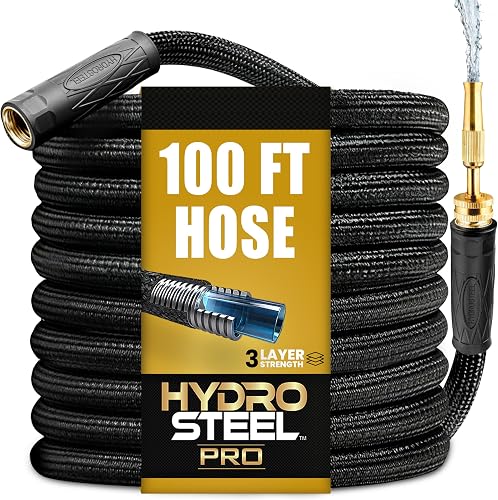
EMSON Hydrosteel PRO 100 Ft Heavy Duty 304 Stainless Steel Metal Garden Hose with Crush Resistant Fittings
As an Amazon Associate we earn from qualifying purchases. Product prices and availability are accurate as of the date/time indicated.
Frequently Asked Questions
Can I replace spray heads with rotary nozzles?
Often yes. Many multi-stream rotary nozzles thread onto existing spray bodies. Confirm the nozzle fits your body, that your pressure is in its range, and that every nozzle on the zone matches. Replace all heads on a zone together.
Which sprinkler is better for a small or narrow yard?
Spray heads, or multi-stream rotary nozzles, usually suit small and narrow areas. Standard rotors throw too far and can wet fences, walks and walls. Check the rotor’s minimum radius on the manufacturer’s chart before using one near a boundary.
How long should I run rotor vs spray sprinklers?
Because sprays apply water roughly 3 to 4 times faster, a typical zone might run about 10-15 minutes for sprays versus 30-45 minutes for rotors. Those are only examples. Run a catch-can test to get real times for your heads.
What happens if my water pressure is too high for spray heads?
Water breaks into fine mist that blows away or evaporates, so less reaches the lawn. Pressure-regulated spray bodies or nozzles help hold the right psi. A pressure gauge on a hose bib gives you a starting reading.
{“@context”: “https://schema.org”, “@type”: “FAQPage”, “mainEntity”: [{“@type”: “Question”, “name”: “Can I replace spray heads with rotary nozzles?”, “acceptedAnswer”: {“@type”: “Answer”, “text”: “Often yes. Many multi-stream rotary nozzles thread onto existing spray bodies. Confirm the nozzle fits your body, that your pressure is in its range, and that every nozzle on the zone matches. Replace all heads on a zone together.”}}, {“@type”: “Question”, “name”: “Which sprinkler is better for a small or narrow yard?”, “acceptedAnswer”: {“@type”: “Answer”, “text”: “Spray heads, or multi-stream rotary nozzles, usually suit small and narrow areas. Standard rotors throw too far and can wet fences, walks and walls. Check the rotor’s minimum radius on the manufacturer’s chart before using one near a boundary.”}}, {“@type”: “Question”, “name”: “How long should I run rotor vs spray sprinklers?”, “acceptedAnswer”: {“@type”: “Answer”, “text”: “Because sprays apply water roughly 3 to 4 times faster, a typical zone might run about 10-15 minutes for sprays versus 30-45 minutes for rotors. Those are only examples. Run a catch-can test to get real times for your heads.”}}, {“@type”: “Question”, “name”: “What happens if my water pressure is too high for spray heads?”, “acceptedAnswer”: {“@type”: “Answer”, “text”: “Water breaks into fine mist that blows away or evaporates, so less reaches the lawn. Pressure-regulated spray bodies or nozzles help hold the right psi. A pressure gauge on a hose bib gives you a starting reading.”}}]}