
When to spray for grubs depends on the product. Apply preventives from late spring to early July, before eggs hatch. Use curatives in late summer to early fall, and only after a count finds roughly 5 to 10 or more grubs per square foot. Dates shift with region, grub species and your product’s label.
Should I use a preventive or a curative grub killer?
Pick by timing, not by brand. Preventives go down before grubs hatch and kill the young ones as they start feeding. Curatives go down after grubs are already feeding and kill the ones in the soil now.
| Type | Common active ingredients | Best window (North) | Use it when |
|---|---|---|---|
| Preventive | Chlorantraniliprole, imidacloprid | Late April to early July, depending on the ingredient and label | You had grub damage last year, or your neighbors did |
| Curative | Trichlorfon, carbaryl | Late summer to early fall, while grubs are small and near the surface | A square-foot count shows grubs above the threshold |
University extension programs such as UMass classify these ingredients this way. Product names and strengths vary, so confirm the active ingredient on the front of the bag and follow the label’s rates and dates.
Choose a preventive if you get grub damage most years. It loses when your lawn has few grubs, because you pay for a treatment you did not need. Choose a curative if you prefer to scout first. It loses when you wait too long, because large grubs in cool soil die less reliably.
When to spray for grubs in the North, Transition zone and South
Grub timing follows the life cycle. Adult beetles fly and lay eggs in summer, eggs hatch into small grubs, the grubs feed on roots through late summer and fall, burrow deeper to overwinter, then feed briefly in spring before pupating. Warmer regions run earlier, so one national date does not work.
| Region (examples) | Preventive window | Curative window | Notes |
|---|---|---|---|
| North (New England, upper Midwest, Great Lakes, Pacific Northwest) | Chlorantraniliprole: roughly late April to mid-June. Imidacloprid: roughly mid-June to early July. Follow your label. | Late July or August through September | Japanese beetle and European chafer are common. Eggs hatch mostly July to August. |
| Transition zone (Mid-Atlantic, Ohio Valley, Missouri, Kentucky) | Roughly May to late June | Roughly July to September | Beetle flights start earlier than in the North. Ask your county extension office for local flight dates. |
| South (Southeast, Gulf states, southern Plains) | Roughly April to June | Late spring through summer when damage and grubs are confirmed | Species vary, and grubs may be less of a problem than other turf pests. Confirm the pest first. |
These ranges are approximations, and sources differ by a few weeks. Your state extension service publishes the dates that fit your climate.
Why the ingredient changes the date
Chlorantraniliprole moves slowly through soil to the root zone, so it goes on earlier. UMass found that imidacloprid applied too early may not last long enough to cover grubs active in July and August. Imidacloprid can also be less effective on some beetle species, so check the label for the grubs it lists.
How many grubs per square foot is a problem?
Many lawns tolerate about 5 grubs per square foot with no visible damage, and extension thresholds for treatment usually fall around 5 to 10 per square foot, depending on species and turf health. Stressed or droughty lawns show damage at lower counts. Local thresholds vary, so check your state extension source.
The cut-a-square-foot test
- Pick a spot at the edge of the damaged area, where living and dying turf meet.
- Cut three sides of a 1-foot square about 3 inches deep with a spade.
- Peel the flap back and look through the top 2 to 3 inches of soil and roots.
- Count the C-shaped, cream-colored grubs with tan heads.
- Repeat in 4 to 5 spots across the lawn and average the results.
Put the sod back and water it. Test in August through September for the best read on this year’s grubs.
Quick signs you have grubs
- Brown, spongy turf that does not respond to watering.
- Turf that pulls up like loose carpet with almost no roots (the tug test).
- Birds, skunks or raccoons digging up patches.
Common mistake: brown turf in July is often drought, dollar spot or chinch bugs. If the sod stays rooted, grubs are not the cause, so do not spray.
Which grub product fits which timing?
| Active ingredient | Type | Typical timing | Watch for |
|---|---|---|---|
| Chlorantraniliprole | Preventive | Often late April to mid-June in the North; timing differs by product label | Goes on earliest. Needs rain or irrigation to reach the roots. |
| Imidacloprid | Preventive; a few labels may allow early curative use, so check yours | Often mid-June to early July in the North; varies by label | Neonicotinoid, harmful to bees. Check which species are on the label. |
| Trichlorfon | Curative | Late summer to early fall | Highly water soluble. Some states or localities restrict use on school grounds or other sites, so rules vary. Check your state. |
| Carbaryl | Curative | Late summer to early fall | Also toxic to bees and other insects. Read the label closely. |
Rates, turf types and restrictions come from the product label, which is the legal instruction. Do not exceed it.
What about organic options?
Milky spore targets only Japanese beetle grubs and performs poorly in cold climates. Beneficial nematodes can work, but they need moist soil, the right species and application in the evening or on a cloudy day. Both are slower and less predictable than synthetic products. They fit a patient prevention plan better than an emergency fix.
How to apply grub control and water it in
- Read the label first for rate, turf types, re-entry time and watering instructions.
- Mow before you apply and remove flowering weeds such as clover and dandelions, so bees are not exposed.
- Calibrate your spreader to the setting on the bag, then apply evenly. Overlapping passes cause double doses and streaks.
- Water in right away with about 0.5 inch of water unless the label says otherwise. This moves the product off the leaves and into the root zone where grubs feed.
- Sweep granules off driveways and sidewalks back onto the lawn.
Skip the application if heavy rain is forecast within the label’s window, because runoff wastes product and can carry it into storm drains and waterways. Keep children and pets off treated turf until it is dry and the label allows. To measure your sprinkler output, use the tuna can trick: set an empty can on the lawn and water until it holds about 0.5 inch.
Fertilizer at the same time? Many combination products exist, and applying a separate fertilizer the same day is usually fine if both labels allow it. Do not stack two insecticides.
Do not use lawn grub products in pots or vegetable beds unless the label specifically lists them.
Safety, pollinators and granular vs. liquid products
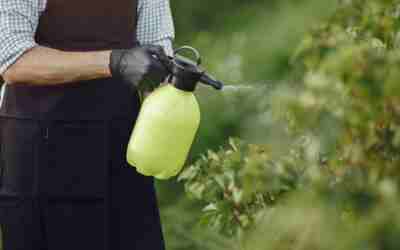
Searches for “when to spray” are often answered with granular products, which you spread and then water in. Liquid sprays follow the same timing, but check the label for the method, protective gear and re-entry time.
- Wear gloves and follow any other protective gear listed on the label. Wash your hands after handling the product.
- Keep granules away from water bodies such as ponds, streams, storm drains and wells. Sweep stray granules back onto the lawn.
- Avoid flowering plants. Do not treat blooming weeds or garden beds, and mow flowering weeds first.
- Protect pollinators. Some active ingredients, including imidacloprid and carbaryl, are toxic to bees. Some labels carry pollinator restrictions, and some local rules limit use, so read yours.
- Store leftovers in the original container, out of reach of children and pets.
Is it too late to treat for grubs in fall or spring?
Fall: A curative works best in late summer to early fall, while grubs are small and close to the surface. Cutoff dates vary by region and product, so ask your state extension office. As soil cools, grubs move deeper, and a late rescue is less likely to work. In the South, the window can run longer, but confirm the pest first.
Spring: Grubs that overwintered feed again as soil warms, then stop to pupate. A curative in early spring can help if a count finds damaging numbers, but the benefit is smaller than a well-timed late summer or early fall treatment. Once grubs stop feeding, a curative mostly misses the damage. Spring is better spent repairing the lawn and planning a preventive.
If you missed the window
- Do nothing to the soil now. Mark damaged areas and plan a preventive for next year’s window.
- Rake out dead turf, loosen the soil and reseed or lay sod when temperatures suit your grass type.
- Keep the new turf watered. A poorly timed late spray is rarely worth it.
Decision rule: if grubs are tiny and above the threshold in August to September, spray a curative. If grubs are large and it is already cold, repair the lawn instead and prevent next year.
Related reading: When to Pull Pork Shoulder Off the Smoker (195-205°F) · Spray vs Rotor Sprinklers: Which Is Right for You? · When to Put Up Hummingbird Feeders: 2 Weeks Before Arrival
Frequently Asked Questions
How long after spraying can pets go on the lawn?
Follow your product label, since re-entry times differ. A common guideline is to keep children and pets off until the treated area is fully dry and any required watering-in is done. Sweep stray granules off hard surfaces before pets go out.
Will grub killer harm earthworms or bees?
It can. Imidacloprid and carbaryl are toxic to bees, and broad-spectrum products like carbaryl can also harm earthworms and other beneficial insects. Mow flowering weeds first, avoid blooming plants, and read the label’s pollinator warnings.
How often should I apply grub control?
Once per season is typical. Preventives are usually applied once a year, and curatives only when a count shows a problem. Do not repeat or combine insecticides beyond what the label allows.
Do I need to treat the whole lawn?
Not always. If grub damage is confined to one area and counts elsewhere are low, a spot treatment may be enough if the label allows. Preventives are usually applied to the whole lawn, so check your product’s directions.
{“@context”: “https://schema.org”, “@type”: “FAQPage”, “mainEntity”: [{“@type”: “Question”, “name”: “How long after spraying can pets go on the lawn?”, “acceptedAnswer”: {“@type”: “Answer”, “text”: “Follow your product label, since re-entry times differ. A common guideline is to keep children and pets off until the treated area is fully dry and any required watering-in is done. Sweep stray granules off hard surfaces before pets go out.”}}, {“@type”: “Question”, “name”: “Will grub killer harm earthworms or bees?”, “acceptedAnswer”: {“@type”: “Answer”, “text”: “It can. Imidacloprid and carbaryl are toxic to bees, and broad-spectrum products like carbaryl can also harm earthworms and other beneficial insects. Mow flowering weeds first, avoid blooming plants, and read the label’s pollinator warnings.”}}, {“@type”: “Question”, “name”: “How often should I apply grub control?”, “acceptedAnswer”: {“@type”: “Answer”, “text”: “Once per season is typical. Preventives are usually applied once a year, and curatives only when a count shows a problem. Do not repeat or combine insecticides beyond what the label allows.”}}, {“@type”: “Question”, “name”: “Do I need to treat the whole lawn?”, “acceptedAnswer”: {“@type”: “Answer”, “text”: “Not always. If grub damage is confined to one area and counts elsewhere are low, a spot treatment may be enough if the label allows. Preventives are usually applied to the whole lawn, so check your product’s directions.”}}]}