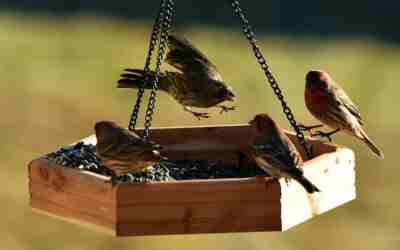
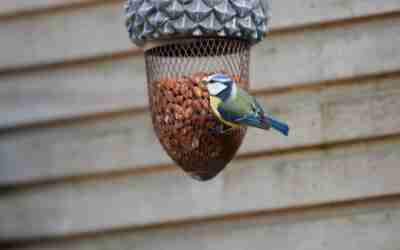
The best place to put a bird feeder is about 10 to 12 feet from a tree or shrub, roughly 5 feet off the ground, and either within 3 feet of a window or more than 30 feet from it. That spot gives birds quick cover, slows squirrels and cats, and cuts window strikes. Here is how to adjust it for your yard.
What is the best place to put a bird feeder? A quick checklist
Use these targets as a starting point. They are rules of thumb from Audubon and other bird-feeding sources, not codes, so adjust for your yard.
| Factor | Target | Why it matters |
|---|---|---|
| Window distance | Within 3 ft, or 30+ ft away | Avoids the collision danger zone |
| Distance to cover | About 10 to 12 ft from trees or shrubs | Birds can dive for safety, but cats and squirrels can’t easily ambush |
| Height | About 5 ft off the ground | Keeps seed out of reach of ground predators and easy for you to refill |
| Sun | Morning sun, afternoon shade | Strong afternoon heat can spoil seed |
| Traffic | Away from doors, grills and pools | Birds avoid noise, smoke and constant movement |
| Access | Reachable without a ladder | Feeders that are hard to reach don’t get cleaned |
You will rarely hit every target. The two that matter most are window distance and predator safety, so settle those first.
How close to a window should a bird feeder be?
Within 3 feet of the glass, or more than 30 feet away. Audubon calls this the “3 or 30” rule. A bird leaving a feeder that close can’t build enough speed to be badly hurt. A feeder 30 feet or more away gives birds room to see and avoid the window.
Why you will see 10, 25 and 30 feet
Some sources use a looser version: within 3 feet or beyond 10 feet. Others say 25 feet or more. The exact far number is a judgment call, not a measured line. What the sources agree on is the bad zone in between, where birds can fly fast but still aim at reflections.
A simple decision rule
- Room for 30 feet? Place it there, ideally where the window isn’t reflecting sky or trees.
- Can’t get 30 feet? Go to 3 feet or less. Don’t settle for 8 to 20 feet.
- Large reflective window nearby? Add exterior decals or close the blinds on that window as well. Placement alone won’t fix it.
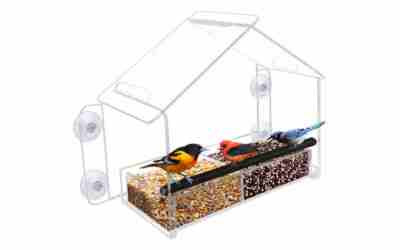
If you want birds right at the glass, a window-mounted feeder is the easiest version of the 3-foot rule. See how to attach a bird feeder to a window and our clear window feeder roundup.
How far from trees and bushes, and how high off the ground?
Birds want an escape route but not a hiding place for predators. Most sources suggest 10 to 15 feet from shelter. That is close enough for a quick dash from a hawk, but far enough that a cat can’t pounce from a branch or a squirrel can’t easily jump on.
Height is usually about 5 feet. That puts the feeder out of reach of most ground predators and lets you refill it standing up. Exact numbers vary by source and by your local predators, so treat them as a starting point.
Worked example: a typical backyard
Say you have a fence along the back, a shrub border on the left, and a maple in the middle of the lawn. Hang or pole-mount the feeder about 10 to 12 feet from the shrub border and at least that far from the fence. Keep it clear of the maple’s low branches. Birds can reach cover in a couple of seconds, but a squirrel has no easy launch point.
Common mistake
Hanging a feeder from a tree branch is convenient, but it gives squirrels a direct path and cats an ambush spot. If your best option is a tree, hang it from the end of a long branch with a baffle above it.
Where to put a bird feeder to keep squirrels and raccoons away
Placement works better than gadgets, and a baffle only works if the feeder sits in the right spot. Squirrels are commonly said to jump roughly 4 feet straight up and 8 to 10 feet sideways. That is a general guideline, so check what your own squirrels manage.
- Choose open ground at least 10 feet from fences, roofs, railings, trees and sheds.
- Use a metal pole, not a wooden post.
- Mount the feeder about 5 feet up.
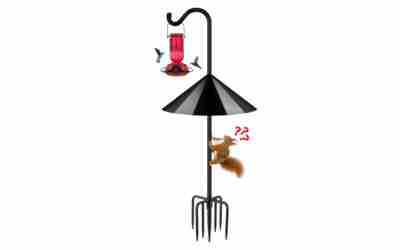
- Install a baffle below the feeder, with the top of the baffle about 4 to 5 feet off the ground. Follow the maker’s instructions, since sizes vary by model.
Read our squirrel baffle roundup for options. Our FEED GARDEN squirrel-proof pole review covers one complete pole setup.
Raccoons and bears
Raccoons climb poles, so bring feeders in at night if they visit. See how to keep raccoons away from bird feeders. If bears are active in your area, take feeders down at night or stop feeding during active months. Your state wildlife agency can tell you when.
Sun, wind, noise and refilling: choosing the exact spot
Once the distances work, pick the spot that is comfortable for birds and for you.
- Sun and shade: Morning sun with afternoon shade is a good balance. Hot afternoon sun can spoil seed, and a spot that stays wet can mold it. A feeder with a roof helps keep seed dry.
- Wind: In winter, a spot sheltered from prevailing wind helps birds conserve energy.
- Quiet: Keep feeders away from doors, grills, pool equipment and dog runs. Smoke, splashing and constant movement keep birds away.
- View: Choose a spot you can see from a kitchen or living room window, but follow the window rule above.
- Access: If you have to haul a ladder or step through flower beds, you will skip cleaning.
Plan for the mess
Seed hulls and droppings build up under feeders. Place the feeder over mulch, gravel or a spot you can rake, not over a deck you love or a patio table. See what to put under a bird feeder to catch seeds and hulls. Rake spilled seed regularly, and clean the feeder on a schedule using our guide on how to clean a bird feeder. Damp seed and droppings can spread disease.
Safety: Keep poles well clear of overhead power lines, and don’t set feeders where people can trip over a pole or a hose.
Where to put a feeder on a small yard, deck or balcony
Small spaces can’t meet every distance, so rank your priorities: window safety first, then predator safety, then everything else.
- Small yard: Put the feeder in the middle of the open area, at least 10 feet from the fence if possible. If not, use a pole with a baffle and a feeder close enough to a window to meet the 3-foot rule.
- Deck: Attach the feeder to a rail clamp or bracket away from the door, and put a tray or mat below. Our deck-mounted bird feeder picks cover options.
- Apartment balcony: Hang it close to the railing, not out in the middle of the balcony, and check your lease or HOA rules before you start. See best bird feeders for an apartment balcony.
- Window: A suction-cup feeder meets the 3-foot rule automatically. The Nature Gear clear acrylic window feeder review is one example.
Not sure what style fits your spot? Start with how to choose a bird feeder.
Why aren’t birds coming to my new feeder, and when should I move it?
It can take days or a few weeks for birds to find a new feeder. Before you move it, check the basics: fresh seed, a clean feeder, a quiet spot and a nearby perch or cover.
If nothing has visited after about 2 to 3 weeks, move it 10 to 20 feet toward cover, or closer to where birds already move through. Change only one thing at a time so you know what worked. The seed also matters, so match it to the birds you want. For example, see our guides for cardinals and chickadees.
Seasonal changes
- Winter: Move the feeder closer to a wind break, and keep paths clear of snow.
- Summer: Shade the feeder from afternoon sun and change seed more often, since it can spoil in heat and humidity.
- Spring and fall: Expect busier traffic during migration. This is a good time to clean.
Our Top Picks
Ready to shop? These are the top-rated options from our hands-on roundup, Best Bird Feeder Pole With Squirrel Baffle of 2026.

Gbekery 89" Bird Feeder Pole with Squirrel Baffle & Double-Hook

Uoveya 79" Bird Feeder Pole Stand with Squirrel Baffle

KFM 92-Inch Bird Feeder Pole with Squirrel Baffle
As an Amazon Associate we earn from qualifying purchases. Product prices and availability are accurate as of the date/time indicated.
Frequently Asked Questions
Should a bird feeder be in sun or shade?
Aim for morning sun and afternoon shade. Sun helps keep seed dry, but strong afternoon heat can spoil it. A roofed feeder in partial shade is a safe choice in hot climates. Check seed often in humid or rainy weather.
Can I hang a bird feeder from a tree?
Yes, but it’s not ideal. Branches give squirrels a launch point and cats an ambush spot. If you do, use the end of a long branch with a baffle above the feeder and keep it well off the ground.
How long does it take birds to find a new feeder?
Anywhere from a few days to a few weeks. If you see no birds after about 2 to 3 weeks, check that the seed is fresh and the spot is quiet, then move the feeder closer to cover.
Is it okay to put a bird feeder near my house?
Yes, if it is within 3 feet of a window or well away from glass. Avoid the middle range. Also keep feeders away from doors and grills, and put something below to catch hulls and keep your siding clean.
{“@context”: “https://schema.org”, “@type”: “FAQPage”, “mainEntity”: [{“@type”: “Question”, “name”: “Should a bird feeder be in sun or shade?”, “acceptedAnswer”: {“@type”: “Answer”, “text”: “Aim for morning sun and afternoon shade. Sun helps keep seed dry, but strong afternoon heat can spoil it. A roofed feeder in partial shade is a safe choice in hot climates. Check seed often in humid or rainy weather.”}}, {“@type”: “Question”, “name”: “Can I hang a bird feeder from a tree?”, “acceptedAnswer”: {“@type”: “Answer”, “text”: “Yes, but it’s not ideal. Branches give squirrels a launch point and cats an ambush spot. If you do, use the end of a long branch with a baffle above the feeder and keep it well off the ground.”}}, {“@type”: “Question”, “name”: “How long does it take birds to find a new feeder?”, “acceptedAnswer”: {“@type”: “Answer”, “text”: “Anywhere from a few days to a few weeks. If you see no birds after about 2 to 3 weeks, check that the seed is fresh and the spot is quiet, then move the feeder closer to cover.”}}, {“@type”: “Question”, “name”: “Is it okay to put a bird feeder near my house?”, “acceptedAnswer”: {“@type”: “Answer”, “text”: “Yes, if it is within 3 feet of a window or well away from glass. Avoid the middle range. Also keep feeders away from doors and grills, and put something below to catch hulls and keep your siding clean.”}}]}