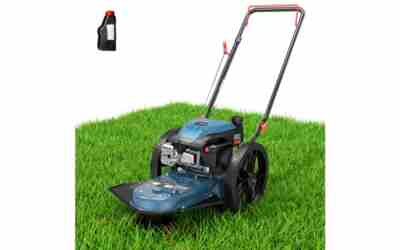

In the weed wacker vs brush cutter choice, use a string trimmer for grass and soft weeds and a bladed brush cutter for woody stems thicker than 1/2 inch.
Weed wacker vs brush cutter: what each tool is
Weed wacker, weed eater and string trimmer are three names for the same tool: a powered shaft with a spinning nylon line head. (Weed Eater is also a brand name.) A brush cutter is a separate category, built to swing a metal blade through tougher growth.
| String trimmer | Brush cutter | |
|---|---|---|
| Cutting head | Nylon line on a bump-feed or auto-feed spool | Metal blade, such as a multi-tooth or saw-tooth type |
| Typical gas engine | About 20-30cc | About 40-50cc |
| Handling | Usually under about 10 lb, held by hands and arms alone | Harness plus a two-handed bar handle |
| Stems it handles | Grass and soft weeds; reinforced line of 0.110 inch or larger for dense, non-woody growth | Woody stems over 1/2 inch; saplings to about 2 inches with a metal blade |
| Where it loses | Line frays and stalls in woody stems | Awkward and risky for fine trimming beside beds, fences and walls |
These capacities are typical figures. The stem rating in your model’s manual overrides them.
Neither tool makes a clean trench along a sidewalk or bed border. For that job, read our weed wacker vs edger comparison.
Weed wacker vs brush cutter for a suburban lot or an acre
On a typical suburban lot, a string trimmer does all the work: fence lines, tree rings, bed edges and slopes the mower cannot reach. A brush cutter would sit in the garage.
On an acre or more with overgrown fields, fence rows or brambles, the brush cutter does the clearing. A string trimmer then handles the finish work around buildings and beds.
Worked example: an overgrown acre
- Blackberry canes at 3/4 inch: thicker than 1/2 inch, so use a blade.
- A 1 1/2 inch sapling: within the roughly 2 inch range, if your brush cutter’s manual rates the blade for it.
- A 3 inch sapling: beyond a brush cutter, so use loppers, a pruning saw or a chainsaw.
- Lawn edge and garden beds afterward: string trimmer.
Result: one brush cutter for clearing plus one trimmer for upkeep, or a single system the maker rates for both heads.
Trap to avoid: do not cut poison ivy with either tool. Spinning line or blades throw plant debris onto your skin and clothes. See can you weed whack poison ivy for safer options.
Can you turn a weed wacker into a brush cutter?
Only with a blade kit that the manufacturer lists for your exact model. A blade puts far more load on the shaft, clutch and engine than line does, and the guard has to contain a metal blade.
Many curved-shaft trimmers are not rated for blades at all. Check the manual before buying any blade.
Do not bolt a universal aftermarket blade onto a trimmer that the maker does not approve for one. The standard line guard is not designed to stop a blade fragment, and an unbalanced blade can cause violent vibration or kickback.
Some brands sell attachment-capable systems where one power unit accepts a line head, a blade or other heads. Those are safe to use as a brush cutter only when the manual lists the blade and the matching guard for that unit.
The reverse also works in some cases. A brush cutter can take a line head if the manual lists one, but it stays heavy for fine trimming.
Power, weight and fuel: gas versus battery
Engine size is only a rough guide. Displacement alone does not set power, so compare the maker’s stated output and blade rating rather than cc alone.
- Gas: more sustained power for dense growth and no battery limit, but you mix fuel, maintain the spark plug and air filter, and put up with noise and exhaust.
- Battery: quiet, with no fuel mixing and easy starts. Runtime depends on pack capacity (Ah) and load, and blades in woody stems draw more power than line in grass, so expect fewer minutes per charge than the grass-cutting figure on the box.
Weight matters more with a blade. A trimmer is held by the arms alone, while a brush cutter’s harness moves the load to your shoulders and hips. Adjust the harness so the head floats just above the ground before you start.
Fuel ratios and battery runtimes are model-specific, so use the numbers in your manual.
Cost of ownership: line, blades and upkeep
- Line: cheap to replace and quick to swap. Our guide on how to restring a weed wacker covers bump-feed heads in nine steps.
- Blades: cost more than line. A cracked, bent or chipped blade must be replaced, not straightened, and a dull blade should be sharpened or swapped per the manual.
- Extras: a brush cutter needs a harness, the correct guard and a full set of protective gear, which a casual trimmer user may not own yet.
One rated system with swappable heads costs less than two separate power units. Two dedicated tools, though, mean each one is balanced and tuned for its own job, and you never swap heads mid-project.
Brush cutter safety: kickback, thrown debris and sparks
A spinning blade is more dangerous than line. Wear eye protection, hearing protection, long pants, sturdy boots and gloves every time.
- Kickback: a blade that hits a solid object such as a trunk, post or buried rock can jerk sideways. Walk the area first and remove rocks and wire.
- Thrown debris: both tools throw material. Keep people and pets well clear, at the distance your manual specifies.
- Sparks: a blade striking stone can ignite dry grass. Skip blade work in dry, fire-prone conditions.
- Setup: always run the guard and harness the maker supplies, and stop the engine or remove the battery before changing a blade or clearing a jam.
Our Top Picks
Ready to shop? These are the top-rated options from our related roundup, Best Weed Wacker For Heavy Brush of 2026.

HieYungo Cordless Weed Wacker 8-inch 2x4.0Ah Batteries
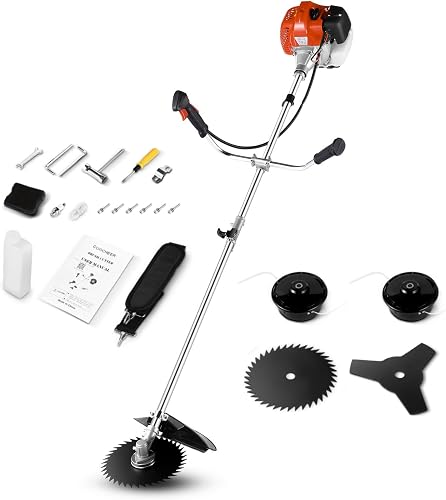
COOCHEER 58CC 4-in-1 Gas Weed Wacker 18.5in Cut
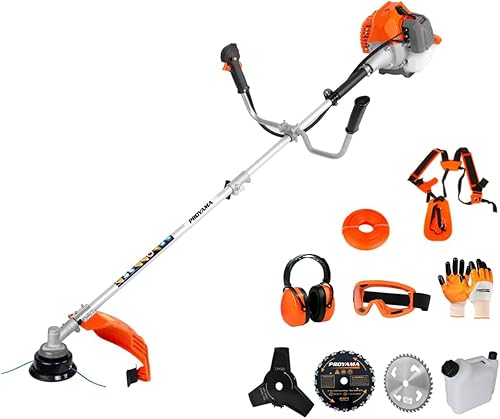
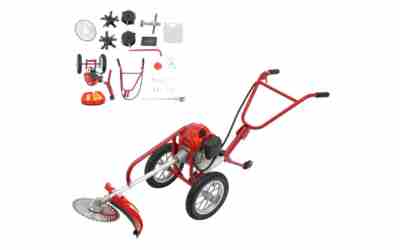
PROYAMA 42.7cc Gas Weed Eater Trimmer
As an Amazon Associate we earn from qualifying purchases. Product prices and availability are accurate as of the date/time indicated.
Frequently Asked Questions
Can a brush cutter be used to trim a lawn?
It can cut grass, but a heavy bladed tool is hard to control near edges and can scalp turf or throw debris. Leave lawn trimming and bed edges to a string trimmer and keep the blade for brush.
Are battery brush cutters as strong as gas ones?
Generally not for sustained heavy work. Battery models handle light brush and thick weeds well, but gas units keep power in dense woody growth. Compare each maker’s stated blade and stem rating, not voltage or cc.
What is the difference between a brush cutter and a clearing saw?
The names overlap. A clearing saw usually means a brush cutter fitted with a saw-tooth blade for woody stems and saplings. Whatever you call it, the manual’s rated blade and stem size decide what it can safely cut.
Can I put a string head on a brush cutter?
Only if the manual lists a line head for that model, and then use the maker’s matching guard. It works for light mowing-style cuts, but the tool stays heavier and less nimble than a trimmer.
{“@context”: “https://schema.org”, “@type”: “FAQPage”, “mainEntity”: [{“@type”: “Question”, “name”: “Can a brush cutter be used to trim a lawn?”, “acceptedAnswer”: {“@type”: “Answer”, “text”: “It can cut grass, but a heavy bladed tool is hard to control near edges and can scalp turf or throw debris. Leave lawn trimming and bed edges to a string trimmer and keep the blade for brush.”}}, {“@type”: “Question”, “name”: “Are battery brush cutters as strong as gas ones?”, “acceptedAnswer”: {“@type”: “Answer”, “text”: “Generally not for sustained heavy work. Battery models handle light brush and thick weeds well, but gas units keep power in dense woody growth. Compare each maker’s stated blade and stem rating, not voltage or cc.”}}, {“@type”: “Question”, “name”: “What is the difference between a brush cutter and a clearing saw?”, “acceptedAnswer”: {“@type”: “Answer”, “text”: “The names overlap. A clearing saw usually means a brush cutter fitted with a saw-tooth blade for woody stems and saplings. Whatever you call it, the manual’s rated blade and stem size decide what it can safely cut.”}}, {“@type”: “Question”, “name”: “Can I put a string head on a brush cutter?”, “acceptedAnswer”: {“@type”: “Answer”, “text”: “Only if the manual lists a line head for that model, and then use the maker’s matching guard. It works for light mowing-style cuts, but the tool stays heavier and less nimble than a trimmer.”}}]}