
A good garden hose is 5/8 inch, 4+ plies and fitted with brass couplings, in a length just past your longest run. Rubber or hybrid suits most yards, while vinyl and expandable hoses fit lighter, occasional watering.
The four specs that separate a good hose from a weak one
Ignore the marketing and check diameter, construction, couplings and certification.
Diameter
Garden hoses come in 1/2, 5/8 and 3/4 inch. The 5/8-inch size is the balanced default: enough flow for most sprinklers and washing, without the weight of 3/4 inch. A 1/2-inch hose is fine for short, light jobs but loses pressure on longer runs, and 3/4 inch moves the most water but is heavy to drag. Our guide on what size garden hose to buy goes deeper on the 5/8 vs 3/4 choice.
Construction
Look for a reinforced, multi-layer wall. As a rule of thumb, 4 or more plies is a good sign, but ply count is not a standardized spec and brands count layers differently, so treat it as a guide rather than a guarantee. Thin single-layer walls kink and split first. Household water pressure is typically 40 to 60 psi, so a burst rating is rarely the limit; wall thickness and reinforcement decide how long a hose lasts.
Couplings
Solid brass couplings outlast plastic or thin aluminum ones, which crack when stepped on or cross-threaded. Hex-shaped brass ends let you tighten with a wrench and keep the threads round after a drop. Decision rule: rule out any hose without brass couplings first, then pick the higher ply count among those left in the same material.
Certification
Most standard hoses are not made for drinking. If water will reach people, pets or edible plants, look for a “drinking water safe” or lead-free label on the package.
Rubber, vinyl, hybrid or expandable: where each wins
Material controls weight, heat tolerance and how long the hose survives sun and cold.
| Type | Weight | Strength | Weak point |
|---|---|---|---|
| Rubber | Heavy | Best UV and hot-water tolerance, stays flexible in cold | Hard to carry and coil |
| Vinyl | Light | Cheapest, fine for light seasonal use | Stiffens in cold, kinks, softens in heat |
| Hybrid (polymer blend) | Medium | Kink resistant and flexible, easier to handle than rubber | Hot-water and UV rating depends on the model |
| Expandable | Very light | Shrinks when drained, easy to store | Inner tube can puncture or fail on rough ground |
Pick rubber if the hose stays outside year-round or touches hot water. Pick hybrid if you drag it around a lot. Expandable hoses suit small patios and balconies; read our Pocket Hose Ballistic expandable review to see how one performs on specs.
How long should a good garden hose be?
Buy the length of your actual run plus a few feet, not the longest hose on the shelf. Extra length adds weight, more kinks and a bigger drop in pressure at the nozzle.
- Walk the path from the spigot to the farthest spot you water, around corners and beds, and measure it with a tape.
- Add 5 to 10 feet for slack at the spigot and the nozzle.
- Round up to the next sold length: 25, 50 or 100 feet.
Worked example (typical values): the path to the back bed measures 62 feet. Adding 8 feet of slack gives 70 feet, so a 75-foot hose fits. If 75 feet isn’t sold in your brand, a 50-foot and a 25-foot hose joined with a coupling cover it and are easier to carry separately.
Longer runs reduce flow, and thinner hoses lose more. The numbers behind this are in our breakdown of garden hose water usage.
Matching a hose to the job
| Job | What to prioritize |
|---|---|
| Everyday watering | 5/8 inch, hybrid or rubber, brass couplings |
| Washing cars and decks | Kink resistance, 5/8 inch, a hose you can drag without it snagging |
| Feeding a pressure washer | The diameter in the washer manual, in a short length |
| Hot summers | Rubber, which resists UV and heat better than vinyl |
| Freezing winters | Rubber or hybrid that stays flexible, plus draining before frost |
| Hot water use | A hose whose label states a hot-water rating; vinyl can fail from heat |
| Drinking, pet bowls, edible beds | A drinking-water-safe, lead-free labeled hose |
Water that sits in a hose in direct sun gets hot, so run it until it feels cool before watering plants or filling bowls. Check the label or manual for any temperature rating, because it is model dependent.
Make a good garden hose last longer
Most hoses fail at the couplings or at a repeated kink, not in the middle of the wall.
- Replace the washer first. A dripping connection usually needs a new rubber washer inside the coupling, not a new hose.
- Hand-tighten only. Over-tightening with pliers crushes washers and plastic ends.
- Coil in loose loops on a reel or hanger instead of folding it. Tight bends create permanent kinks.
- Keep it out of full sun when not in use, which slows cracking of the outer layer.
- Drain and disconnect before freezing weather. Trapped ice can split the hose and damage the spigot.
Coil hoses away from walkways so no one trips on them. Stainless steel hoses need different care; see whether stainless steel garden hoses are good for their pros and cons.
Compare hoses that meet these specs
Once you know your diameter, length and material, compare models on ply count, coupling metal and the drinking-water label. Our heavy-duty garden hose comparison lines up hoses that meet the rubber and brass-coupling criteria above.
Our Top Picks
Ready to shop? These are the top-rated options from our related roundup, Best Garden Hoses That Do Not Kink of 2026.

ToolasinGardenHose 50FT Stainless Steel Metal Garden Hose with 10-Function Nozzle, No-Kink and Leak-Proof Design

UNCO 75ft Stainless Steel Metal Garden Hose with 4-Function Brass Nozzle - Kink-Free Heavy Duty Design
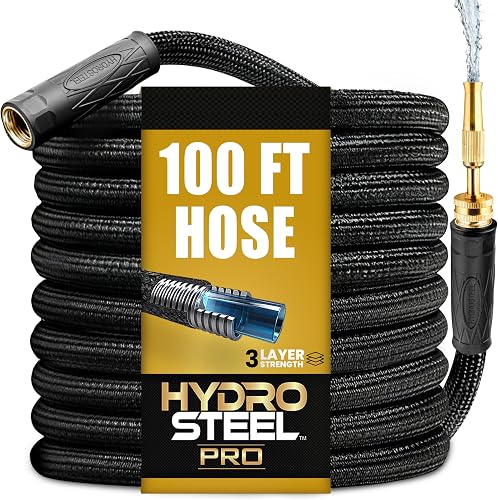
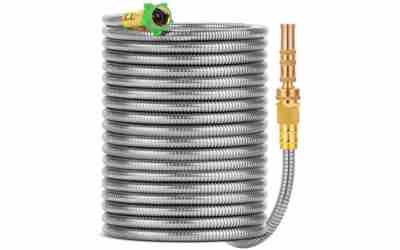
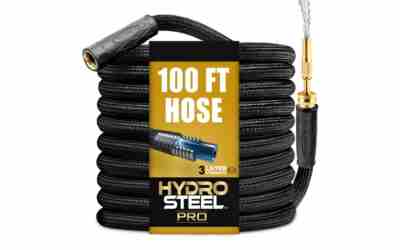
EMSON Hydrosteel PRO 100 Ft Heavy Duty 304 Stainless Steel Metal Garden Hose with Crush Resistant Fittings
As an Amazon Associate we earn from qualifying purchases. Product prices and availability are accurate as of the date/time indicated.
Frequently Asked Questions
Can I leave a hose out in winter?
Not if freezing weather is coming. Drain the hose and disconnect it from the spigot first, because trapped ice can split the hose and damage the spigot.
Can I join two hoses to reach farther?
Yes, with a brass male-to-female coupling. Use matching diameters and fresh washers at the joint, and expect a slightly lower flow at the end than with one continuous hose of the same total length.
Is a garden hose safe to drink from?
Not unless the label says it is drinking water safe or lead-free. Most standard hoses are not made for drinking, so don’t use them for people, and check the label before filling pet bowls.
Can I connect a chemical sprayer straight to my hose?
Not without protection. Fit a backflow preventer or vacuum breaker at the spigot first, so fertilizer or pesticide cannot be drawn back into your household water supply.
{“@context”: “https://schema.org”, “@type”: “FAQPage”, “mainEntity”: [{“@type”: “Question”, “name”: “Can I leave a hose out in winter?”, “acceptedAnswer”: {“@type”: “Answer”, “text”: “Not if freezing weather is coming. Drain the hose and disconnect it from the spigot first, because trapped ice can split the hose and damage the spigot.”}}, {“@type”: “Question”, “name”: “Can I join two hoses to reach farther?”, “acceptedAnswer”: {“@type”: “Answer”, “text”: “Yes, with a brass male-to-female coupling. Use matching diameters and fresh washers at the joint, and expect a slightly lower flow at the end than with one continuous hose of the same total length.”}}, {“@type”: “Question”, “name”: “Is a garden hose safe to drink from?”, “acceptedAnswer”: {“@type”: “Answer”, “text”: “Not unless the label says it is drinking water safe or lead-free. Most standard hoses are not made for drinking, so don’t use them for people, and check the label before filling pet bowls.”}}, {“@type”: “Question”, “name”: “Can I connect a chemical sprayer straight to my hose?”, “acceptedAnswer”: {“@type”: “Answer”, “text”: “Not without protection. Fit a backflow preventer or vacuum breaker at the spigot first, so fertilizer or pesticide cannot be drawn back into your household water supply.”}}]}