
Garden hose water usage is typically 5 to 10 gallons per minute, or 300 to 600 gallons per hour, for a standard hose at normal home pressure.
Why some hose flow numbers look higher than 10 GPM
You may see hose flow figures online that are well above 10 gallons per minute (GPM). Those are usually theoretical maximums for a short, wide, unrestricted hose with plenty of pressure behind it. They describe what the hose could carry, not what your house delivers.
Your outdoor spigot is the real limit. Water pressure, the size of your home’s supply line and how many other fixtures are running all cap the flow. That is why the 5 to 10 GPM range is the practical one for most homes, whatever hose you attach.
Treat every published number as a starting point. Your own flow depends on your pressure, hose diameter, hose length and the attachment on the end. The bucket test below gives you your own figure in a couple of minutes, and every calculation in this guide builds on it.
What changes how much water a hose delivers
Standard garden hoses come in 1/2, 5/8 and 3/4 inch inside diameters. A wider hose can carry more water, but only if the spigot can supply it. These factors move your flow up or down:
- Pressure: higher pressure pushes more water through the same hose, and low pressure cuts the flow.
- Length: friction inside the hose reduces flow, so a longer run delivers less at the end than a short one.
- Diameter: a wider hose loses less pressure over distance, which matters most on long runs. Our guide on what size garden hose to buy compares 5/8 and 3/4 inch.
- Kinks: a kink acts like a partial shutoff and drops flow sharply until you straighten it.
- Attachments: nozzles, sprinklers and splitters each restrict the flow in their own way.
Because so many factors stack up, two homes with identical hoses can see very different flow. Measuring beats guessing.
How to measure your own flow with a bucket
The bucket test gives you a real number for your hose, spigot and nozzle.
- Attach the hose and nozzle or sprinkler you normally use, and unroll the hose so it is not kinked.
- Open the spigot fully, as you would when watering.
- Start a timer and fill a 5-gallon bucket.
- Stop the timer when the bucket is full.
- Divide 5 gallons by the time in minutes. That is your GPM.
Use this table to read your result. Find the fill time closest to yours, then read across to your hourly and 30-minute totals.
| Time to fill 5 gallons | Flow | Gallons per hour | Gallons in 30 minutes |
|---|---|---|---|
| 30 seconds | 10 GPM | 600 | 300 |
| 50 seconds | 6 GPM | 360 | 180 |
| 1 minute | 5 GPM | 300 | 150 |
| 1 minute 40 seconds | 3 GPM | 180 | 90 |
| 2 minutes 30 seconds | 2 GPM | 120 | 60 |
Test with the nozzle or sprinkler you actually use, not an open hose end. That is the flow that counts for your water bill. If your result falls between rows, divide 5 by your minutes and multiply by 60 for gallons per hour.
How many gallons a 30-minute watering session uses
Multiply your measured GPM by the minutes the water runs. Then multiply by your water rate.
For this worked example, assume a bucket test that fills 5 gallons in 50 seconds, which is 6 GPM.
- One 30-minute session: 6 GPM × 30 minutes = 180 gallons.
- Three sessions a week for four weeks: 12 sessions × 180 gallons = 2,160 gallons.
The $5 per 1,000 gallons rate below is a typical placeholder value for illustration, not a local price. Your own rate will differ, so check your bill.
- One session: 180 ÷ 1,000 × $5 = $0.90.
- One month: 2,160 ÷ 1,000 × $5 = $10.80.
Swap in your own GPM, minutes and rate to get your real cost. Some cities also set watering days or hour limits, so check your local rules before setting a schedule.
Matching your total to your water bill
Utilities do not all bill in gallons. Some bill per 1,000 gallons, and others bill per hundred cubic feet (CCF). One CCF equals about 748 gallons.
Using the monthly total from the example, 2,160 gallons ÷ 748 is about 2.9 CCF. Look at your bill for the unit and the rate, and check whether a separate sewer charge applies to the water you use outdoors.
Comparing the gallons you calculate with the usage line on your bill is the easiest way to see how much of your total comes from the hose.
How nozzles, sprinklers and soaker hoses change water use
A hose only moves as much water as the thing on the end lets through. Your spigot sets the ceiling, and the attachment sets the actual flow.
- Open hose end: the highest flow your setup can give, and the easiest way to waste water.
- Shutoff nozzle: the flow while spraying is the same, but it stops the moment you let go. The savings come from the pauses between plants.
- Sprinkler: flow depends on the model and your pressure, so bucket test it with the sprinkler attached. The real cost is run time, since a sprinkler is easy to forget.
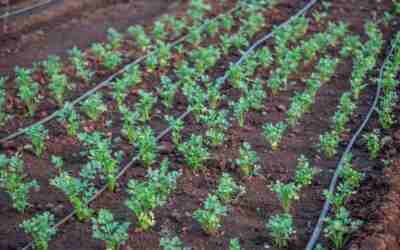
- Soaker hose or drip line: flow depends on the product and your pressure, so measure it the same way. Slow watering at the soil also loses less water to wind and evaporation. For beds, see the best way to water raised garden beds.
If you run a sprinkler or soaker line, put it on a timer. A 30-minute cutoff prevents the two-hour accident and keeps your total close to the number you calculated.
Our Top Picks
Ready to shop? These are the top-rated options from our hands-on roundup, Best Garden Hoses That Do Not Kink of 2026.

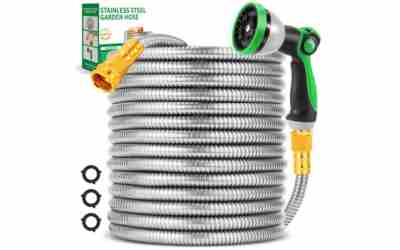
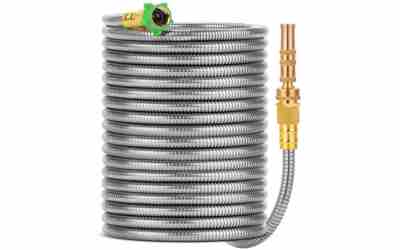
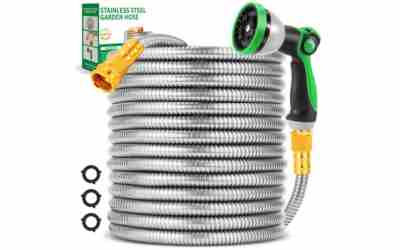
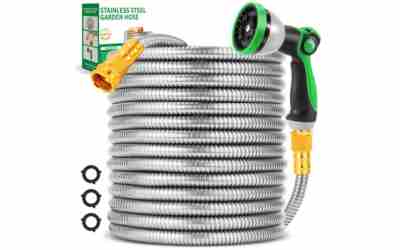
ToolasinGardenHose 50FT Stainless Steel Metal Garden Hose with 10-Function Nozzle, No-Kink and Leak-Proof Design

UNCO 75ft Stainless Steel Metal Garden Hose with 4-Function Brass Nozzle - Kink-Free Heavy Duty Design
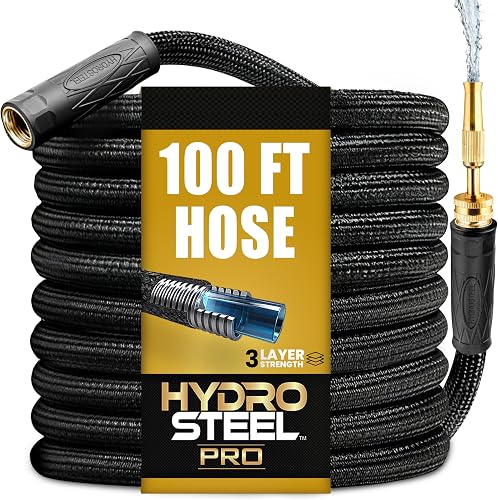
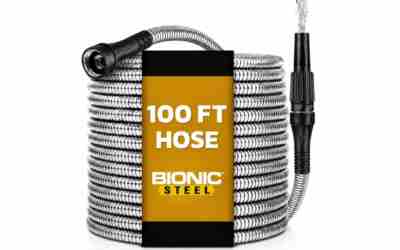
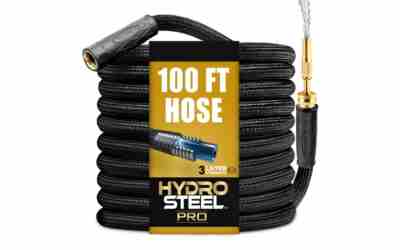
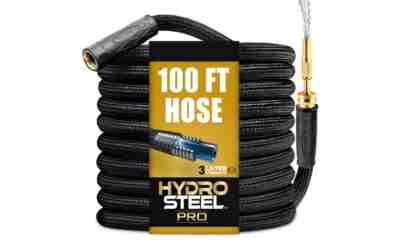
EMSON Hydrosteel PRO 100 Ft Heavy Duty 304 Stainless Steel Metal Garden Hose with Crush Resistant Fittings
As an Amazon Associate we earn from qualifying purchases. Product prices and availability are accurate as of the date/time indicated.
Frequently Asked Questions
Does a hose use more water than a sprinkler?
Not by itself. Both draw from the same spigot, so whichever restricts the flow less uses more water per minute. Bucket test each one and compare the GPM.
Does a pressure regulator reduce water use?
It can only lower pressure, and lower pressure lowers flow. If your pressure is already below the regulator’s setting, it changes nothing. Bucket test before and after.
How much water does a hose use for a car wash?
It depends on your measured GPM and how long the water runs. At the 6 GPM example, a 10-minute wash uses 60 gallons. Shutting the nozzle between rinses lowers that total.
Does a 3/4-inch hose use more water than a 5/8-inch hose?
Only if your spigot can supply more. The spigot usually limits flow, so the main benefit of a 3/4-inch hose is less pressure loss on long runs.
Can I run two sprinklers off one hose?
Yes, with a splitter, but they share the same flow. At 6 GPM total, each sprinkler gets only part of it, so coverage drops. Bucket test with both attached.
{“@context”: “https://schema.org”, “@type”: “FAQPage”, “mainEntity”: [{“@type”: “Question”, “name”: “Does a hose use more water than a sprinkler?”, “acceptedAnswer”: {“@type”: “Answer”, “text”: “Not by itself. Both draw from the same spigot, so whichever restricts the flow less uses more water per minute. Bucket test each one and compare the GPM.”}}, {“@type”: “Question”, “name”: “Does a pressure regulator reduce water use?”, “acceptedAnswer”: {“@type”: “Answer”, “text”: “It can only lower pressure, and lower pressure lowers flow. If your pressure is already below the regulator’s setting, it changes nothing. Bucket test before and after.”}}, {“@type”: “Question”, “name”: “How much water does a hose use for a car wash?”, “acceptedAnswer”: {“@type”: “Answer”, “text”: “It depends on your measured GPM and how long the water runs. At the 6 GPM example, a 10-minute wash uses 60 gallons. Shutting the nozzle between rinses lowers that total.”}}, {“@type”: “Question”, “name”: “Does a 3/4-inch hose use more water than a 5/8-inch hose?”, “acceptedAnswer”: {“@type”: “Answer”, “text”: “Only if your spigot can supply more. The spigot usually limits flow, so the main benefit of a 3/4-inch hose is less pressure loss on long runs.”}}, {“@type”: “Question”, “name”: “Can I run two sprinklers off one hose?”, “acceptedAnswer”: {“@type”: “Answer”, “text”: “Yes, with a splitter, but they share the same flow. At 6 GPM total, each sprinkler gets only part of it, so coverage drops. Bucket test with both attached.”}}]}