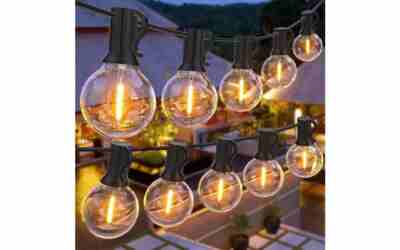

To hang outdoor lights, fasten them to solid anchors no more than 10 feet apart, 7 to 10 feet above the ground, and plug into a GFCI outlet.
Plan the layout and count strands and hooks
Measure the route before you buy anything. Lay a string or tape along the path the lights will follow, including every turn, and write down each straight run in feet.
Then use two quick formulas:
- Strand length: total run length plus 10% for gentle swags, rounded up to the next common strand size.
- Anchor points: keep anchors no more than 10 feet apart. For each run, divide its length by 10 and round up to get the number of gaps. Add all the gaps together, then add 1.
Worked example: three sides of a 12 x 16 ft patio
- Runs: 12 ft + 16 ft + 12 ft = 40 ft
- Add 10% for swags: 40 x 1.1 = 44 ft, so buy a 48 ft strand
- Gaps: 12 ft needs 2 gaps (6 ft each), 16 ft needs 2 gaps (8 ft each), 12 ft needs 2 gaps (6 ft each), which is 6 gaps
- Anchors: 6 + 1 = 7 hooks or clips, plus a couple of spares
Check your strand’s instructions, because some sets specify closer attachment points than 10 feet.
Materials checklist: strands, hooks or clips for your surface, a level or string line, a tape measure, a drill with bits, a ladder, UV-rated zip ties, an outdoor-rated extension cord, and a GFCI outlet or GFCI adapter.
Pick hardware for wood, brick, stucco and vinyl siding
Match the fastener to the surface so you hold the load without cracking, leaking or scarring the finish.
| Surface | Hardware | Why |
|---|---|---|
| Wood fascia or post | Screw-in cup hooks or eye screws, with a pilot hole | Threads bite into solid wood and carry the load |
| Brick | Brick clips that hook over the face, or a masonry anchor in a mortar joint | Mortar is softer than brick, so drilling it avoids cracks |
| Stucco | Screw hook into the wood framing behind it, or a masonry anchor sealed with exterior caulk | Stucco alone is brittle, and sealant keeps water out of the hole |
| Vinyl siding | Siding hooks that slip under the lower lip | No holes, so no water behind the siding |
| Gutter | Gutter clips that grip the lip | No drilling into the gutter or fascia |
| Metal railing | UV-rated zip ties or small carabiners | Nothing to drill, and easy to remove |
Never use nails or staples on shingles, siding or wiring. Adhesive hooks and suction cups suit only a short, light strand on a clean, smooth surface. Suction cups need about a day to set before you hang anything. Neither belongs on a span that carries tension.
Hang lights between posts with a support cable
Any gap longer than the spacing in the layout section needs a support cable. The cable carries the tension, and the light strand only hangs from it.
- Cable: galvanized or stainless wire rope. Choose a size whose rated load is well above the weight of the lights, and follow the cable maker’s guidance.
- Hardware: an eye bolt at each end, a turnbuckle to tighten, and cable clamps to finish the loops. Use hardware that has a stated load rating.
- Posts: use sturdy posts tall enough to keep the lights at the height in step 2, set firmly in the ground or in concrete. Let the concrete cure for the time on the bag before you apply tension.
Tightening a cable pulls the end posts inward. If a post leans while you tighten, it is not set deep enough, so brace it or reset it before you go on.
Fasten the strand to the cable with UV-rated zip ties or small carabiners at every hang loop. Do not tension the strand’s own wire, because it is not built to carry load.
How to hang outdoor lights step by step
- Test every strand on the ground. Plug it in, then check for dead sections, frayed wire and cracked bulbs. Do not hang a damaged strand.
- Mark the hang points. Set them 7 to 10 feet above the ground, and keep the lowest point at 7 feet over any walkway so nobody hits the bulbs. Use a level or a string line so the heights match.
- Install the hardware. Drill pilot holes for wood and masonry, and seal any holes in stucco. Use a spotter on the ladder, and skip the job in wet or windy weather. Stay well clear of power lines.
- Run the support cable if any gap is over 10 feet, and tighten the turnbuckle.
- Hang the strand starting at the outlet end. Set each loop or clip on its hook, and leave 2 to 3 inches of slack in every span because the wire expands and contracts with temperature.
- Plug in at dusk to check the glow, then adjust any hook that is too tight or too sagging.
For a patio-focused walkthrough with a different layout, see our guide on how to put up outdoor patio lights.
Power outdoor string lights safely
Use only lights, extension cords and power strips marked for outdoor use. Plug into a GFCI-protected outlet and press its test button first. Keep plugs and connections off the ground and out of standing water, ideally inside a weatherproof in-use cover.
Sockets and bulbs must also suit the exposure, so read our explanation of wet and damp ratings for outdoor bulbs before swapping any.
Load math for a 15-amp circuit
A 15 A circuit at 120 V delivers 1,800 W. Lights run for hours, so keep the continuous load to 80% of that, which is 1,440 W.
Find the wattage printed on each strand’s label, then divide 1,440 by it to see how many strands fit on an otherwise empty circuit. Also follow the manufacturer’s maximum number of connected strands, which is often the real limit. Other things on the same circuit, such as a pool pump or garage outlets, reduce your budget.
Hardwiring lights or adding an outdoor outlet should be done by a licensed electrician to meet the National Electrical Code and local rules.
Leaving hung outdoor lights up all year
Leave them up only if the packaging says the strand is rated for year-round outdoor use. Standard seasonal strands can become brittle in UV and deep cold.
Check connections and bulbs twice a year, and take lights down before severe storms if the cable or hooks look strained. Lifespan also depends on the type of lights, which we cover in how long outdoor LED lights last.
When you remove a strand, coil it loosely around a spool or piece of cardboard rather than stuffing it into a bin. That keeps the wire from kinking.
Our Top Picks
Ready to shop? These are the top-rated options from our hands-on roundup, Best Outdoor String Lights of 2026.

GPATIO 100FT LED Waterproof Dimmable Outdoor String Lights

Svater 105FT S14 Commercial Grade Outdoor String Lights

Brightever 100FT Outdoor String Lights, Dimmable, Waterproof
As an Amazon Associate we earn from qualifying purchases. Product prices and availability are accurate as of the date/time indicated.
Frequently Asked Questions
Can I hang string lights from a tree?
Yes. Hang the strand from a hook on a sturdy branch or use a cable between two trees. Do not staple into the trunk or wrap tightly. Use loose loops and check them each year, because the tree keeps growing.
Is a 100-foot strand too long for a 12 x 12 patio?
Yes. A 12 x 12 patio needs roughly 50 to 60 feet. A 100-foot strand will sag and bunch unless you double the runs or crisscross them. Buy a shorter strand or plan a zigzag pattern.
Can I hang lights on a rental without drilling?
Yes. Use siding hooks, gutter clips or UV-rated zip ties on railings. For open yards, use freestanding poles with heavy weighted bases. Take poles down in high wind, since a base alone will not hold against strong gusts.
Can I plug different brands of string lights together?
No. Connect strands only to the same model, up to the maximum on the label. Mixing brands can overload the thinner wire. Give each different brand its own outlet, or use a GFCI-protected outdoor power strip.
{“@context”: “https://schema.org”, “@type”: “FAQPage”, “mainEntity”: [{“@type”: “Question”, “name”: “Can I hang string lights from a tree?”, “acceptedAnswer”: {“@type”: “Answer”, “text”: “Yes. Hang the strand from a hook on a sturdy branch or use a cable between two trees. Do not staple into the trunk or wrap tightly. Use loose loops and check them each year, because the tree keeps growing.”}}, {“@type”: “Question”, “name”: “Is a 100-foot strand too long for a 12 x 12 patio?”, “acceptedAnswer”: {“@type”: “Answer”, “text”: “Yes. A 12 x 12 patio needs roughly 50 to 60 feet. A 100-foot strand will sag and bunch unless you double the runs or crisscross them. Buy a shorter strand or plan a zigzag pattern.”}}, {“@type”: “Question”, “name”: “Can I hang lights on a rental without drilling?”, “acceptedAnswer”: {“@type”: “Answer”, “text”: “Yes. Use siding hooks, gutter clips or UV-rated zip ties on railings. For open yards, use freestanding poles with heavy weighted bases. Take poles down in high wind, since a base alone will not hold against strong gusts.”}}, {“@type”: “Question”, “name”: “Can I plug different brands of string lights together?”, “acceptedAnswer”: {“@type”: “Answer”, “text”: “No. Connect strands only to the same model, up to the maximum on the label. Mixing brands can overload the thinner wire. Give each different brand its own outlet, or use a GFCI-protected outdoor power strip.”}}]}